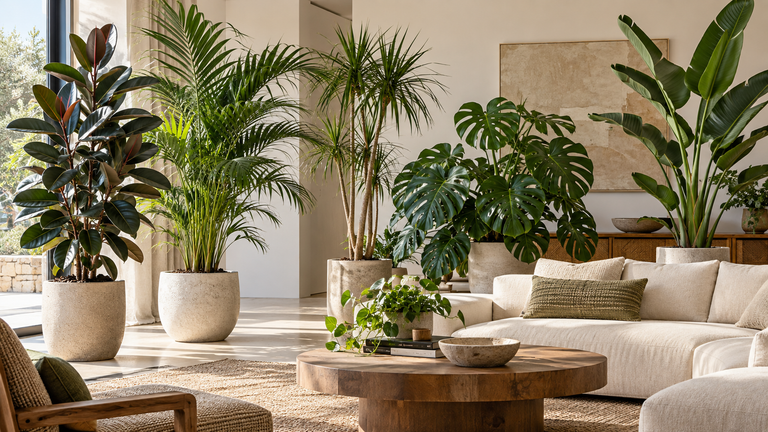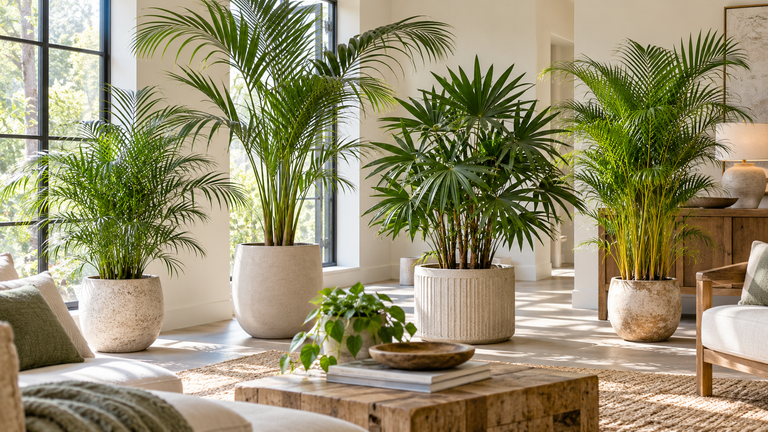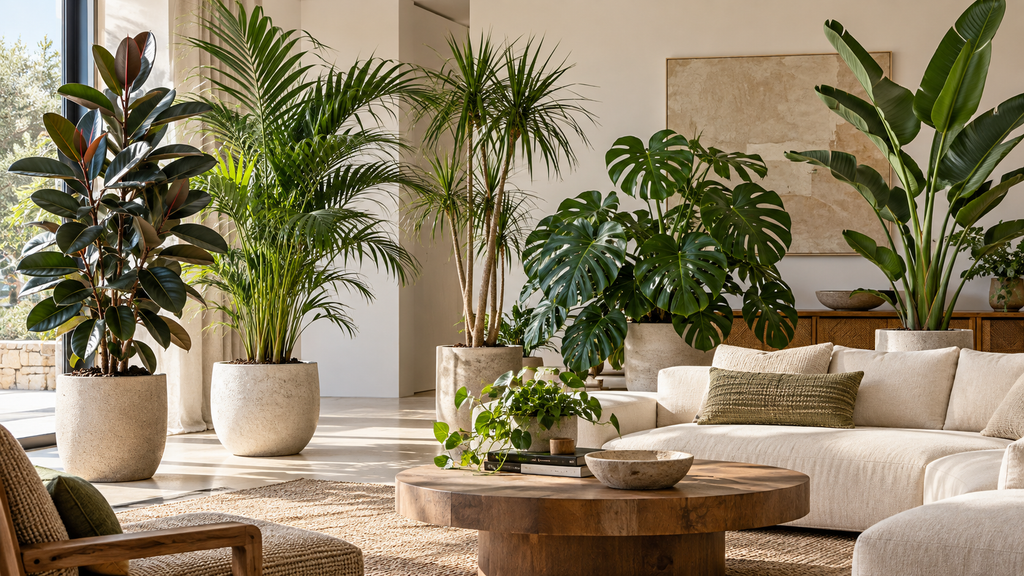
Tall indoor plants such as Rubber Plant, Dragon Tree, Kentia Palm, Monstera, and White Bird of Paradise can add height, structure, and greenery to a room. For lower light, consider Dragon Tree or Kentia Palm; for narrow spaces, choose Dragon Tree or Snake Plant; for bright, spacious rooms, Rubber Plant, Monstera, and White Bird of Paradise are stronger options.
Tall houseplants can fill empty corners, soften large furniture, create a natural focal point, and bring vertical balance to living rooms, offices, and bedrooms. But choosing the tallest plant is not always the best decision. Light, mature width, ceiling height, planter size, and ease of maintenance are just as important.
For this guide, tall indoor plants are floor-grown houseplants capable of developing enough height to act as a vertical feature rather than a tabletop plant.
How to Choose Tall Indoor Plants
Choose a tall indoor plant by eliminating species that do not fit your room before comparing appearance. The most important factors are usable light, mature width, total height, growth form, and maintenance access.
Start with the exact location where the plant will sit. A room may look bright while the corner several feet from the window receives relatively little useful light. Plants that tolerate lower light may survive there, but they usually grow more slowly than they would in brighter suitable conditions.
Measure both vertical and horizontal space. The final height includes the plant, planter, stand, support, and future growth. A 6-foot plant in a tall floor planter can easily approach a standard ceiling.
Width matters just as much. Dragon Tree and Snake Plant grow mainly upward, while palms, Monstera, and White Bird of Paradise can spread much farther sideways.
Use this simple Plantsaholic process:
- Check usable light.
- Measure ceiling clearance.
- Measure mature width.
- Identify the growth form.
- Consider pets, walkways, furniture, and maintenance access.
- Eliminate plants that fail any major condition.
The best plant is the one that fits your room naturally rather than one you constantly have to prune, move, or compensate for.
Best Tall Indoor Plants
| Plant | Typical Indoor Size | Light | Growth Form | Best For | Main Limitation |
|---|---|---|---|---|---|
| Rubber Plant | 4–10 ft | Bright indirect | Tree canopy | All-round statement plant | Better growth in good light |
| Kentia Palm | 5–10+ ft | Medium–bright indirect | Arching palm | Elegant interiors | Needs frond clearance |
| Dragon Tree | 5–10+ ft | Medium; tolerates lower light | Narrow upright | Tight corners | Less dense canopy |
| Corn Plant | 4–8 ft | Medium; tolerates lower light | Cane/upright | Beginners | Less dramatic |
| Fiddle Leaf Fig | 5–10 ft | Bright indirect | Tree canopy | Bright focal points | Less forgiving |
| White Bird of Paradise | 6–10+ ft | Very bright | Broad architectural | High ceilings | Needs light and width |
| Monstera | 5–10+ ft supported | Bright indirect | Supported climber | Large foliage | Needs support and width |
| Money Tree | 4–7 ft | Bright indirect | Tree form | Apartments | Not a true low-light plant |
| Umbrella Plant | 5–8+ ft | Bright indirect | Branching canopy | Indoor-tree effect | Spreading growth |
| Snake Plant | 3–6 ft | Low–bright indirect | Narrow upright | Tight spaces | Limited canopy |
| Lady Palm | 4–8 ft | Medium–bright indirect | Clustered palm | Refined rooms | Needs width as it matures |
| Areca Palm | 5–8 ft | Bright indirect | Arching palm | Tropical rooms | Wide fronds |
| Norfolk Island Pine | 5–8+ ft | Bright indirect | Tiered tree | Tree silhouette | Needs balanced light |
| Yucca Cane | 5–8+ ft | Bright | Narrow architectural | Sunny interiors | Poor fit for dim rooms |
| Ficus Audrey | 5–10 ft | Bright indirect | Tree canopy | Softer tree form | Needs good light |
Indoor size varies with cultivar, age, light, pruning, container size, and growing conditions.
Tall Indoor Plant Growth Types
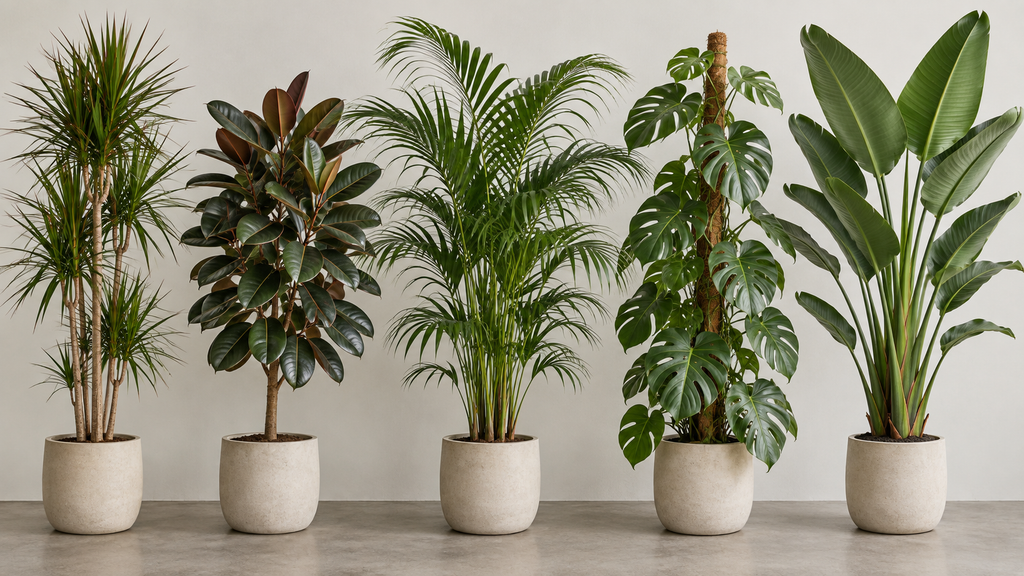
Tall plants use space differently, even when they reach similar heights.
Narrow Upright
Dragon Tree and Snake Plant grow mainly upward. They are good choices when floor width is limited but ceiling height is available.
Tree Canopy
Rubber Plant, Fiddle Leaf Fig, and Ficus Audrey develop a trunk or main stems with foliage spreading higher up. They need more upper-room clearance than narrow cane plants.
Arching Palm
Kentia Palm and Areca Palm produce fronds that extend outward. They work best in open corners where foliage will not interfere with furniture or walkways.
Supported Climber
Monstera can be trained upward on a pole or support. Without support, it spreads horizontally and uses much more floor space.
Broad Architectural
White Bird of Paradise produces tall stems with large paddle-shaped leaves. It needs both height and width.
The key rule is simple: equal height does not mean equal space requirement.
Before Buying Tall Indoor Plants
Before buying a mature plant, make sure it can enter your home and remain practical after it grows.
Measure doorways, staircases, elevators, and tight hallway turns. Large plants can be difficult to transport even when the final room has enough space.
Also consider maintenance. You should be able to reach the soil, inspect leaves for pests, wipe foliage, prune where appropriate, and adjust supports without moving half the room.
The planter also affects the final fit. Tall decorative pots add height and can become extremely heavy once filled with soil and a mature plant.
A large plant is a better purchase when you have already considered:
- delivery access;
- final light level;
- planter height;
- mature width;
- watering access;
- ability to move the plant later.
Easiest Tall Indoor Plants
Dragon Tree, Corn Plant, Snake Plant, Rubber Plant, and Yucca Cane are among the easiest tall indoor plants when their basic requirements are met.
Choose according to your likely challenge:
- Lower light: Dragon Tree.
- Irregular watering: Snake Plant.
- Bright, drier room: Yucca Cane.
- Large glossy leaves: Rubber Plant.
- Easy cane-form floor plant: Corn Plant.
Easy care does not mean neglect-proof. These plants simply tolerate a wider range of conditions than more sensitive options such as Fiddle Leaf Fig.
If you tend to overwater, choose a plant that tolerates drying better. If your room is darker, prioritize light tolerance rather than buying a bright-light species and trying to compensate with extra water or fertilizer.
Tall Indoor Plants for Low Light
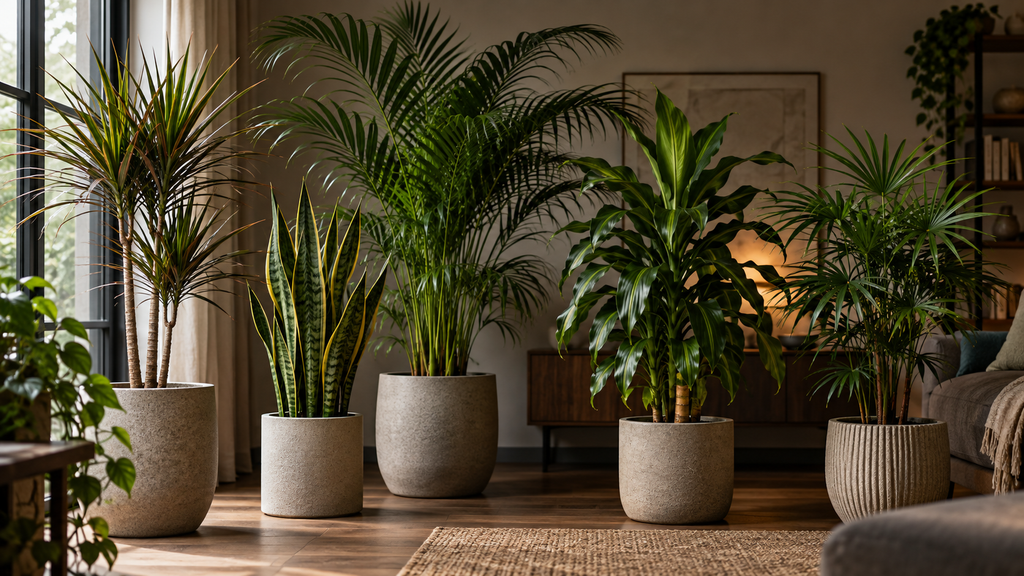
Dragon Tree, Corn Plant, Kentia Palm, Lady Palm, and Snake Plant are among the better tall choices for lower-light interiors.
The important distinction is between tolerating lower light and growing strongly in it. A plant may remain healthy in a dimmer position while producing new growth much more slowly.
For different situations:
- Narrow lower-light corner: Snake Plant or Dragon Tree.
- Tree-like form: Dragon Tree or Corn Plant.
- Softer palm look: Kentia Palm or Lady Palm.
If your goal is to grow the plant taller, provide the brightest suitable indirect light the species can comfortably handle.
A room with no useful natural light is different from a low-light room and may require an appropriate grow light.
Tall Indoor Plants for Living Rooms
Choose a living-room plant according to the size and brightness of the available corner.
For a narrow corner, Dragon Tree works well because its foliage sits above slim stems.
For a medium bright corner, Rubber Plant provides large leaves and a strong focal point without spreading as widely as a mature Monstera.
For a large bright corner, White Bird of Paradise or Monstera can provide stronger tropical impact.
For an elegant open corner, Kentia Palm adds height with softer arching fronds.
The best living-room plant is not the most fashionable one. It is the one that can grow naturally without blocking traffic, pressing against furniture, or struggling for light.
Extra Tall Indoor Plants
Extra tall indoor plants work best in lofts, stairwells, large living rooms, and spaces with high ceilings.
Strong options include Kentia Palm, White Bird of Paradise, Rubber Plant, Fiddle Leaf Fig, Ficus Audrey, Dragon Tree, and supported Monstera.
Before buying an extra-tall specimen, check more than ceiling height. You also need to consider whether you can reach the upper foliage for cleaning, pest inspection, pruning, and support adjustments.
Dragon Tree is useful when you want height without much width. White Bird of Paradise is better when the room can support both height and broad leaves. Kentia Palm adds vertical scale with a softer form.
Do not use outdoor maximum height as an indoor expectation. Container growth, light, pruning, and root space usually keep houseplants much smaller than landscape specimens.
Tall Indoor Plant Botanical Names
Botanical names help prevent confusion when checking mature size, care, and pet safety.
Some popular houseplants still appear under older scientific names in nurseries and databases.
- Snake Plant: Dracaena trifasciata, formerly widely known as Sansevieria trifasciata.
- Umbrella Plant: Heptapleurum arboricola, often still sold as Schefflera arboricola.
- Areca Palm: Chrysalidocarpus lutescens, also commonly listed as Dypsis lutescens.
- White Bird of Paradise: Strelitzia nicolai.
- Ficus Audrey: Ficus benghalensis ‘Audrey’.
- Yucca Cane: commonly associated with Yucca gigantea.
You do not need to memorize the names. Simply check the botanical label before relying on species-specific care or toxicity information.
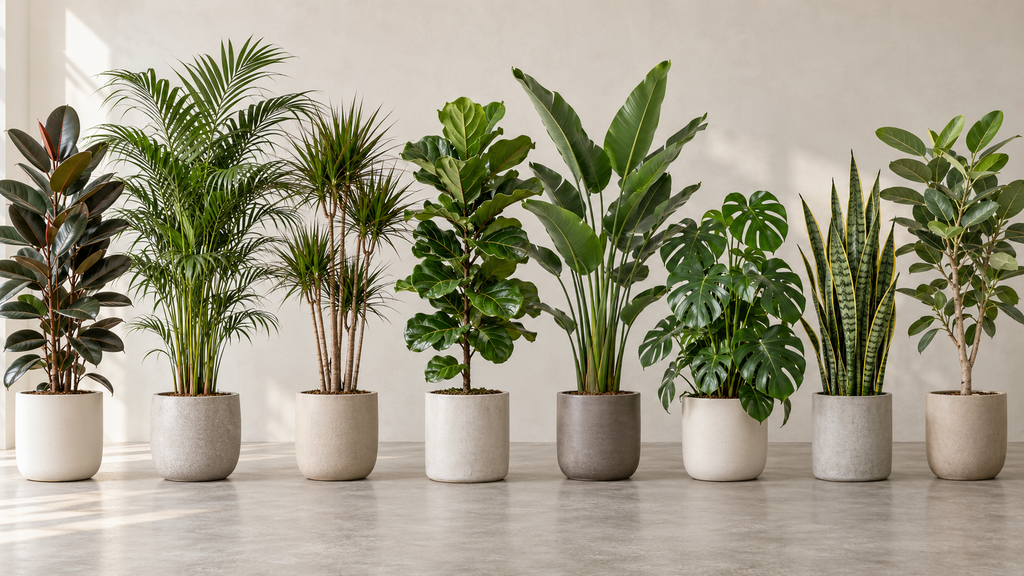
15 Best Tall Indoor Plants
1. Rubber Plant
Ficus elastica is one of the best all-round tall houseplants. Its large glossy leaves create a strong visual presence without the huge spread of some tropical plants.
It prefers good indirect light and should be watered according to soil moisture rather than a strict weekly schedule.
Best for: bright living rooms and offices.
Avoid when: the available position is consistently dim.
Choose instead: Dragon Tree for lower light or a narrower footprint.
2. Kentia Palm
Howea forsteriana offers elegant height with arching fronds. It tolerates lower indoor light better than many large statement plants, although brighter filtered light supports stronger growth.
Best for: open living rooms and refined interiors.
Avoid when: fronds would interfere with furniture or walkways.
Choose instead: Dragon Tree for less horizontal spread.
3. Dragon Tree
Dracaena marginata is one of the best tall indoor plants for limited floor space.
Its slim stems carry narrow foliage above furniture, giving strong vertical height without a large footprint.
Best for: beginners, offices, and narrow corners.
Avoid when: you want dense foliage from floor level.
Choose instead: Rubber Plant for a fuller canopy.
4. Corn Plant
Dracaena fragrans combines sturdy canes with arching foliage and is widely used as an easy floor plant.
It tolerates ordinary household conditions well and can handle moderately lower light.
Best for: beginners and moderate-light rooms.
Avoid when: you want a dramatic high-ceiling specimen.
Choose instead: Dragon Tree or Rubber Plant.
5. Fiddle Leaf Fig
Ficus lyrata creates a strong indoor-tree silhouette with large leaves.
It can become an impressive focal plant but performs best when light, watering, and placement remain reasonably consistent.
Best for: bright rooms.
Avoid when: the location is dim or conditions change frequently.
Choose instead: Rubber Plant for a more forgiving alternative.
6. White Bird of Paradise
Strelitzia nicolai is one of the best extra tall indoor plants for bright, spacious rooms.
Its huge paddle-shaped leaves provide exceptional architectural impact.
Best for: high ceilings and very bright rooms.
Avoid when: light or floor width is limited.
Choose instead: Kentia Palm or Dragon Tree.
7. Monstera
Monstera deliciosa can become very large when trained upward on a sturdy support.
Its mature leaves develop characteristic splits and openings, making it one of the most recognizable tropical houseplants.
Best for: oversized foliage and spacious rooms.
Avoid when: you need a narrow plant.
Choose instead: Dragon Tree.
8. Money Tree
Pachira aquatica offers a lighter indoor-tree form and is often sold with braided trunks.
It works well in apartments and home offices where a very broad plant would be impractical.
Best for: medium-size rooms and offices.
Avoid when: the location is very dark.
Choose instead: Corn Plant for greater lower-light tolerance.
9. Umbrella Plant
Heptapleurum arboricola develops a branching canopy with clusters of radiating leaflets.
It can be pruned to control height and shape.
Best for: a fuller indoor-tree look.
Avoid when: mature spread would block walkways.
Choose instead: Dragon Tree for naturally narrow growth.
10. Snake Plant
Dracaena trifasciata is one of the best tall indoor plants for tight spaces.
Its leaves grow mainly upward, making it ideal for narrow corners.
Best for: lower light, offices, and limited floor space.
Avoid when: you want a branching tree canopy.
Choose instead: Dragon Tree.
11. Lady Palm
Rhapis excelsa develops clusters of slender stems topped with fan-shaped leaves.
It provides a refined palm appearance and handles moderate indoor light well.
Best for: offices and elegant interiors.
Avoid when: available floor width is extremely limited.
12. Areca Palm
Chrysalidocarpus lutescens creates a full tropical effect with arching feather-like fronds.
It needs more horizontal space than cane plants.
Best for: broad corners and tropical interiors.
Avoid when: fronds would interfere with foot traffic.
Choose instead: Kentia Palm for a softer, less dense look.
13. Norfolk Island Pine
Araucaria heterophylla has a tiered tree shape that differs from broad tropical foliage.
It works best in good light where its balanced form can be maintained.
Best for: bright rooms and structured tree silhouettes.
Avoid when: light is weak.
14. Yucca Cane
Yucca gigantea has stiff architectural leaves and performs best in bright indoor conditions.
It also tolerates drying better than many tropical floor plants.
Best for: sunny interiors.
Avoid when: the room is dim.
Choose instead: Dragon Tree for better lower-light adaptability.
15. Ficus Audrey
Ficus benghalensis ‘Audrey’ provides a softer-looking indoor-tree silhouette than Fiddle Leaf Fig.
Its oval leaves and branching form suit bright living rooms and offices.
Best for: bright interiors and tree-like structure.
Avoid when: good usable light is unavailable.
Choose instead: Rubber Plant.
Tall Indoor Plants by Light Level
For lower light, consider Dragon Tree, Corn Plant, Kentia Palm, Lady Palm, and Snake Plant.
For medium indirect light, Rubber Plant, Money Tree, Corn Plant, Kentia Palm, and Umbrella Plant are useful options.
For bright indirect light, consider Monstera, Fiddle Leaf Fig, Ficus Audrey, Rubber Plant, Areca Palm, and Norfolk Island Pine.
For very bright rooms, White Bird of Paradise and Yucca Cane are particularly strong choices.
Do not deliberately keep a plant in weak light simply to slow growth. Poor light can produce weak or one-sided growth rather than a healthy compact plant.
How Much Space Do Tall Indoor Plants Need?
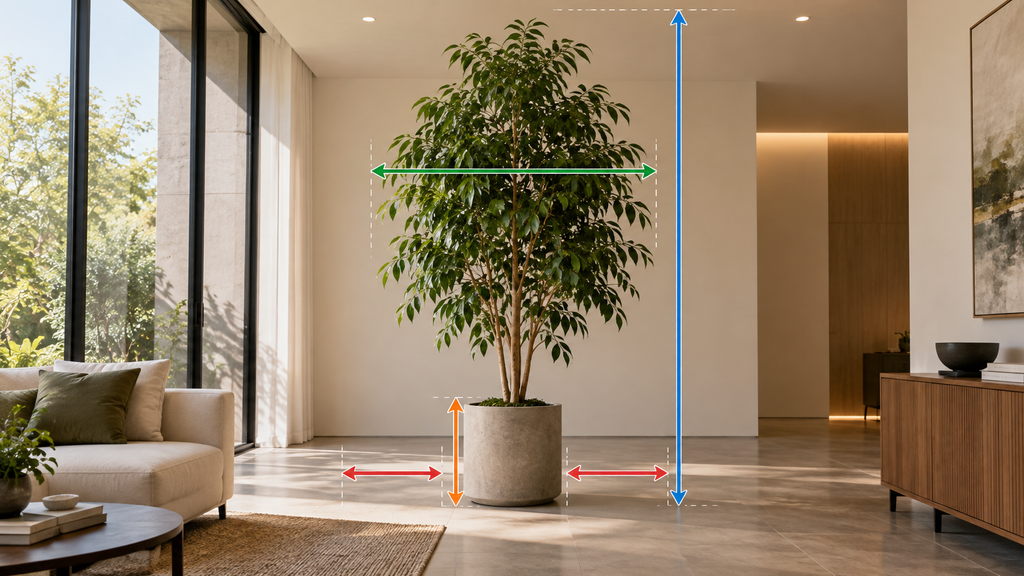
A tall indoor plant needs more room than its listed height and pot diameter suggest.
Think in terms of three dimensions.
Vertical space: plant + planter + stand + support.
Horizontal space: mature canopy, leaves, or fronds.
Maintenance space: enough room to water, inspect, clean, rotate, prune, and move the plant.
A 7-foot Dragon Tree may fit beside a desk, while a 7-foot White Bird of Paradise may need a large open corner.
A plant truly fits only when it has enough room to grow and enough room to be maintained.
Best Pots for Tall Indoor Plants
Tall plants need containers that provide drainage, appropriate root space, and physical stability.
Do not move a plant directly into an oversized pot simply because it is tall. Extra potting medium can stay wet for too long when roots do not yet fill the container.
Increase pot size gradually.
For top-heavy plants, choose a sufficiently stable base. If using a decorative outer pot without drainage, keep the plant in a draining nursery container and remove standing water after watering.
Also consider mobility. Large ceramic or stone planters can become difficult to move, especially when seasonal light changes require a different position.
How to Care for Tall Indoor Plants
Water according to soil moisture and environmental conditions rather than a fixed calendar.
Drying speed changes with light, temperature, season, pot size, and root density.
Clean large leaves periodically. Rubber Plant, Monstera, Fiddle Leaf Fig, and White Bird of Paradise can collect visible dust, and cleaning also gives you a chance to inspect for pests.
Rotate plants gradually when strong one-sided light causes uneven growth.
Repot only when there is a reason, such as severe root crowding, very rapid drying, instability, or declining growth.
Signs a Tall Indoor Plant Does Not Fit
| What You Notice | Check First | Likely Issue | Decision |
|---|---|---|---|
| Plant leans toward window | Light | Too weak or one-sided | Improve position |
| New leaves get smaller | Light and vigor | Conditions limit growth | Diagnose before fertilizing |
| Leaves block walkway | Mature width | Wrong growth form | Relocate or replace |
| Soil stays wet too long | Pot size and light | Slow drying | Review container and watering |
| Plant touches ceiling | Total height | Too little vertical space | Prune if suitable or relocate |
| Plant tips easily | Pot stability | Top-heavy growth | Improve base stability |
Ask: Would this problem still exist if I watered perfectly?
If yes, the issue may be the plant-location match rather than routine care.
Can Tall Indoor Plants Go Outside?
Many tall indoor plants can spend warm periods outdoors, but move them gradually.
Indoor-grown leaves can burn if suddenly exposed to strong outdoor sun. Start in protected shade or bright indirect outdoor light, then increase exposure according to the species.
Before bringing plants back indoors, inspect leaves, stems, and pots for mites, scale, mealybugs, and other pests.
Outdoor suitability depends on climate and species. A plant that can live outdoors year-round in a frost-free region may need to remain indoors for most of the year in colder climates.
Should You Buy a Mature Tall Indoor Plant?
Buy a mature plant if immediate height is important and you have already confirmed the final location.
Choose a smaller plant if lower cost, easier transport, and gradual adaptation matter more.
Before purchasing a large specimen, check:
- doorway width;
- stair access;
- elevator size;
- ceiling clearance;
- final planter;
- ability to reach the plant for care.
A smaller plant that thrives and grows into the room can be a better long-term purchase than an expensive mature specimen placed in poor conditions.
Which Tall Indoor Plant Is Best for You?
Best overall: Rubber Plant
Best beginner options: Dragon Tree and Corn Plant
Best lower-light options: Kentia Palm and Dragon Tree
Best narrow-space options: Snake Plant and Dragon Tree
Best oversized foliage: Monstera
Best bright-room statement: White Bird of Paradise
Best elegant palm: Kentia Palm
Best indoor-tree look: Ficus Audrey or Fiddle Leaf Fig
Best sunny, drier-room option: Yucca Cane
Use the final decision process:
Check light → check mature width → calculate total height → check household constraints → choose from the plants that remain.
The best tall indoor plant is not simply the tallest or most popular plant. It is the one whose natural growth form and care needs match the space you can realistically provide.
Tall Indoor Plants FAQs
What indoor plant can grow the tallest indoors?
Kentia Palm, White Bird of Paradise, Dragon Tree, Rubber Plant, Fiddle Leaf Fig, and supported Monstera can all become very tall indoors. Final size depends on light, container size, pruning, support, and age.
Which indoor plants can grow 6 feet or taller?
Rubber Plant, Dragon Tree, Corn Plant, Kentia Palm, Fiddle Leaf Fig, White Bird of Paradise, Monstera, and Ficus Audrey can reach around 6 feet or more indoors.
How tall should an indoor plant be for an 8-foot ceiling?
A plant around 5–6 feet tall usually leaves practical room for the planter and future growth. Always calculate the total plant-and-pot height.
Can grow lights help tall indoor plants?
Yes. A suitable grow light can supplement weak natural light, but it should illuminate a useful portion of the canopy rather than only the top leaves.
Can tall indoor plants survive without windows?
Only with suitable artificial lighting. No living plant can remain healthy indefinitely in complete darkness.
Why is my tall indoor plant leaning toward the window?
Strong leaning usually means the plant is reaching toward better light. Check light at foliage level and adjust its position gradually.
Can you prune a tall plant that reaches the ceiling?
Many Ficus and Dracaena can be pruned, but pruning depends on species. Do not automatically top palms or plants with a critical growing point.
Which tall indoor plants are safer for pets?
Kentia Palm and Areca Palm are commonly considered safer choices for homes with cats and dogs. Always verify the exact botanical species before purchase.
Should I buy a mature tall plant or a smaller one?
Buy mature for immediate visual impact. Choose smaller for lower cost, easier transport, gradual acclimation, and more control over long-term growth.
Myra is the founder and lead writer of Plantsaholic. She shares practical, research-backed advice on indoor plants, outdoor gardening, flowers, herbs, succulents, and everyday plant care. Her goal is to help gardeners of all experience levels grow healthier plants through simple, easy-to-follow gardening guides.