Repot indoor plants when healthy roots have genuinely filled their available space, the potting mix has stopped working well, or a root problem requires intervention. Spring or another period of active growth is usually easiest, but the plant’s condition matters more than a fixed date.
Knowing when to repot indoor plants is more important than following a yearly schedule. Some fast-growing houseplants can fill a small nursery pot quickly, while slower or mature plants may remain comfortable in the same container for several years.
Repotting also does not always mean moving a plant into a bigger pot. Sometimes the correct solution is to refresh old potting mix, reuse the same container, or choose a smaller pot after major root loss.
The safest approach is to assess the roots, potting mix, watering behavior, growth rate, and current growing conditions before making a change.
Repot, Refresh, Rescue, or Wait?
Not every plant with root or soil problems needs the same treatment. Before repotting, decide what you are actually trying to correct.
Wait when the plant is healthy, roots still have space, soil drains normally, and watering behavior has not changed significantly.
Refresh when the roots have enough room but the potting mix has become compacted, difficult to wet, or structurally poor.
Repot or pot up when healthy roots densely fill the container and the plant clearly needs more space.
Rescue when roots are damaged, rotting, or sitting in a root environment that is actively harming the plant.
A mature plant may also be repotted into the same container when the goal is to maintain its current size. If severe root loss has occurred, a smaller pot may sometimes be more appropriate because the remaining roots may not be able to use the moisture held by a larger container.
The key question is not simply, “Does this plant need repotting?”
Ask:
What change will actually improve its root environment?
Signs Your Houseplant Needs Repotting
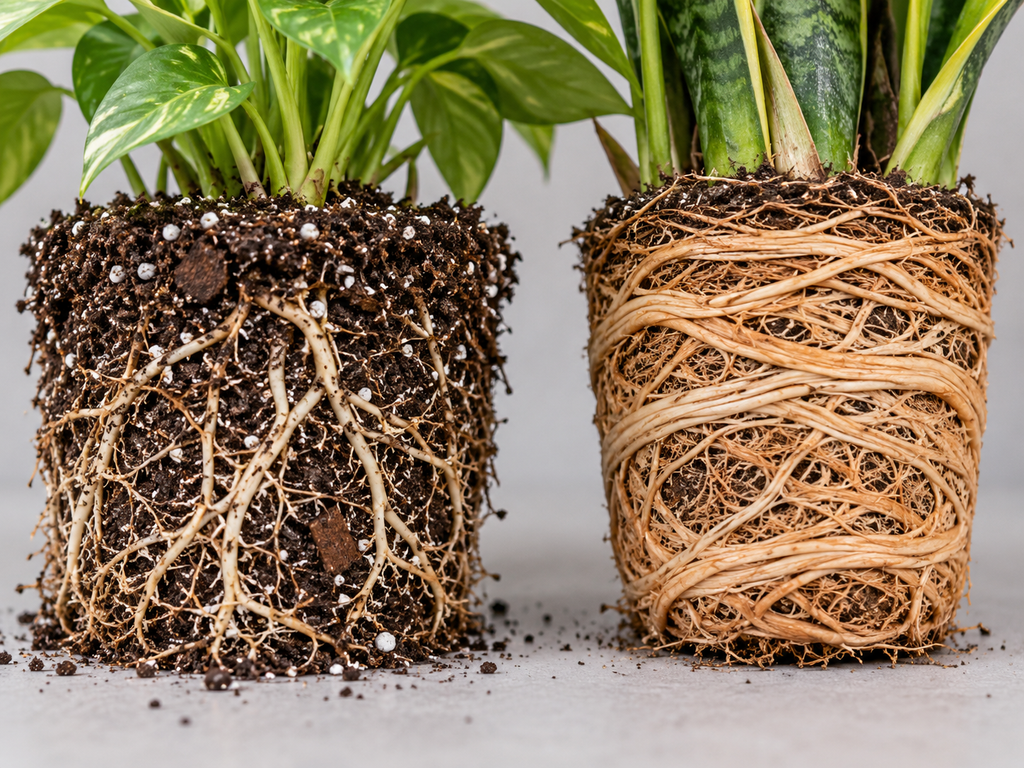
The strongest evidence usually comes from the root ball rather than from one visible symptom.
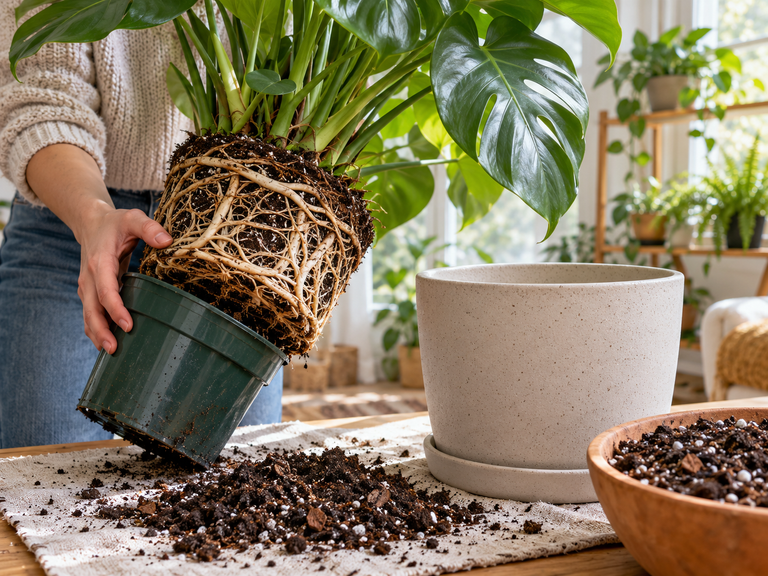
One root growing through a drainage hole does not automatically mean the plant needs a larger container. Carefully remove the plant and inspect the entire root mass.
A plant that still has plenty of loose potting mix between healthy roots may not need repotting yet. If the root ball is mostly dense roots with little usable mix remaining, repotting becomes much more justified.
Strong signs include:
- dense roots circling the root ball;
- very little loose potting mix remaining;
- many roots growing through drainage holes;
- roots appearing heavily at the soil surface;
- potting mix drying much faster than before;
- frequent wilting between normal waterings;
- smaller new leaves;
- reduced growth during an active growing period;
- badly compacted or degraded potting mix.
Rapid drying is particularly useful when combined with root congestion. If a plant that once needed watering every seven days suddenly becomes dry every two or three days, inspect the roots before simply increasing watering frequency.
Not every symptom proves the plant is root-bound. One yellow leaf, temporary drooping, or slow winter growth can result from many other causes.
The best evidence comes from several matching signs rather than one isolated symptom.
Pot Size, Soil, or Root Problem?
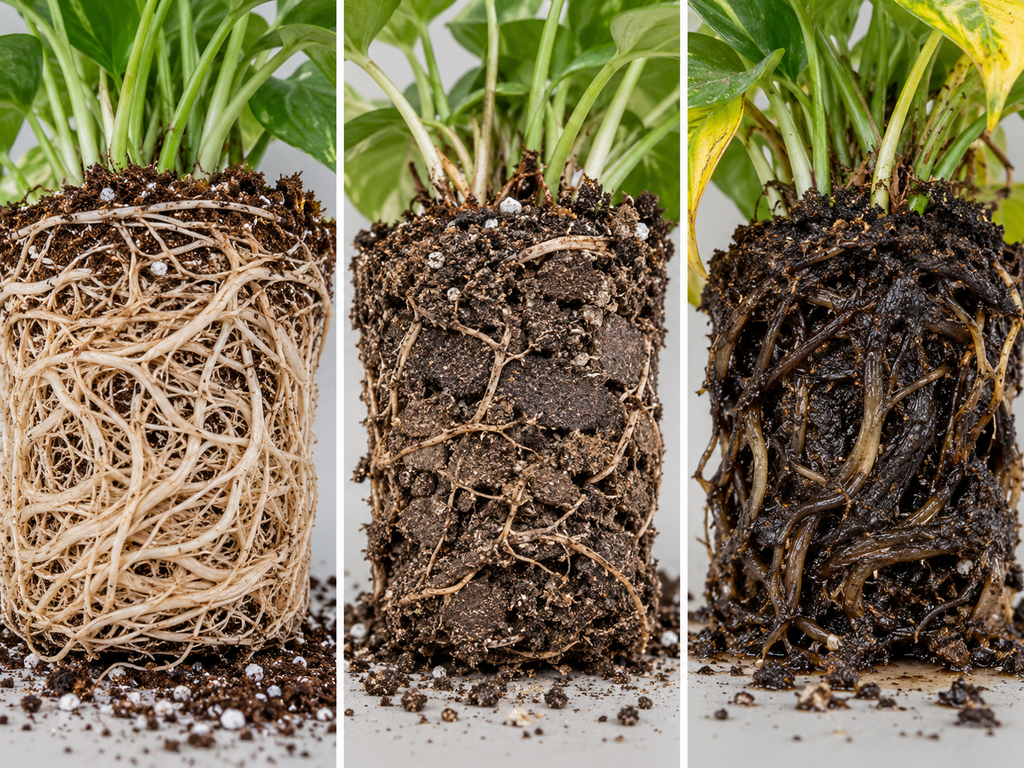
Many symptoms that look like a small-pot problem can come from something else.
Wilting can indicate overcrowded roots, but it can also happen when damaged roots cannot absorb water properly. Slow growth may result from root congestion, but low light, cool temperatures, pests, or poor nutrition can produce similar symptoms.
Before choosing a larger pot, decide whether the main problem is root space, potting-medium condition, or root health.
Pot size is more likely to be the issue when:
- healthy roots densely occupy the container;
- little usable growing medium remains;
- roots circle tightly;
- the pot dries much faster than before;
- growth has slowed despite otherwise suitable care.
The potting mix may be the main problem when:
- roots still have adequate space;
- soil has become compacted;
- water runs down the sides rather than soaking in;
- the mix has shrunk away from the pot;
- drainage behavior has changed.
Root health may be the main problem when:
- soil stays wet for a long time;
- the plant wilts even though the soil is moist;
- roots are soft, dark, or decaying;
- the growing medium smells unpleasant.
A bigger pot only solves a lack-of-space problem. It does not correct unhealthy roots or poor moisture management.
Which Repotting Option Is Best?
Once you know what is happening, choose the smallest intervention that solves the problem.
Wait
Leave the plant alone when roots still have room, the potting mix works well, and the plant is healthy.
Unnecessary repotting adds root disturbance without providing a clear benefit.
Refresh the Soil
If the growing medium has deteriorated but the plant does not need more root space, replace some or all of the old potting mix without automatically increasing container size.
Large established plants may also benefit from replacing the upper layer of old mix when full repotting is unnecessary.
Pot Up
Move the plant into a slightly larger pot when healthy roots genuinely fill the current container and continued growth is wanted.
Root Rescue
If roots are damaged or rotting, the goal is to restore healthy root conditions rather than simply provide more space.
That may involve removing badly damaged tissue, replacing unhealthy medium, improving drainage, and choosing a pot that matches the healthy roots that remain.
When to Repot Indoor Plants
The best time to repot most indoor plants is during active growth.
For many houseplants in temperate regions, this often occurs in spring through early summer. A growing plant is generally better positioned to establish new roots in fresh potting mix and recover from minor disturbance.
In much of the Northern Hemisphere, March through May is often favorable. In much of the Southern Hemisphere, the equivalent spring period usually occurs around September through November.
These months are guidelines, not absolute rules.
A serious root problem should not be left untreated simply because the calendar says it is the wrong season.
Repot sooner if you find:
- root rot;
- severe drainage failure;
- a broken container;
- badly deteriorated potting mix;
- persistent waterlogging;
- severe root congestion causing decline.
The exact time of day matters much less than root condition, moisture, temperature, and aftercare. Morning can be convenient because you have time to monitor drainage afterward, but evening repotting is not automatically harmful.
For global growers, the plant’s growth state matters more than the calendar. A plant growing under strong artificial light in a warm home may remain active during winter, while another plant in a cool, dark room may slow dramatically.
Repotting Houseplants in Winter
Houseplants can be repotted in winter when necessary, but healthy slow-growing plants usually benefit from waiting until stronger growth resumes.
Lower seasonal light often means slower growth and slower water use. Fresh potting mix, particularly in a larger container, may therefore remain moist for longer than expected.
Repot in winter when:
- root rot is present;
- drainage has failed;
- the current container is damaged;
- soil remains dangerously wet;
- the growing medium has badly deteriorated;
- root congestion is causing obvious decline.
Consider waiting when:
- the plant is healthy;
- roots still have space;
- the potting mix is functioning normally;
- growth has simply slowed because of seasonal conditions.
If winter repotting is necessary, keep the change conservative. Use an appropriately sized pot, a suitable airy medium, good drainage, and careful watering.
How Often Should You Check for Repotting?
There is no fixed schedule that applies to every indoor plant.
Fast-growing plants in bright, warm conditions may fill their containers quickly, while slow-growing or mature plants can remain in the same pot much longer.
A better rule is:
Inspect regularly; repot conditionally.
Check more often when:
- the plant is young and growing rapidly;
- it receives strong light;
- the nursery pot is small;
- watering frequency is increasing;
- active growth is vigorous.
Check less often when:
- growth is naturally slow;
- the plant is mature;
- roots still have usable space;
- watering behavior remains stable;
- the potting mix still functions well.
Instead of asking, “Has it been a year?” ask, “Has the plant outgrown its current root environment?”
When Not to Repot a Plant
Do not repot a healthy plant simply because you think fresh soil or a bigger pot must always be better.
Yellow leaves, drooping, slow growth, and leaf loss can also result from:
- overwatering;
- underwatering;
- insufficient light;
- temperature stress;
- pests;
- normal leaf aging.
One drainage-hole root or one yellow leaf is not enough to justify repotting.
Avoid unnecessary repotting when roots still have adequate space, the soil remains functional, or the plant has recently experienced another major change such as transport, relocation, or a sudden change in light.
The exception is when the root environment itself is causing the stress.
Should You Repot a New Plant?
Usually, a healthy newly purchased plant does not need immediate repotting.
A new houseplant has already experienced transportation, handling, and changes in light, humidity, and temperature. Giving it a short period to acclimate allows you to observe whether the current pot and soil are actually creating problems.
Inspect:
- leaves and stems;
- visible pests;
- drainage holes;
- soil moisture;
- root congestion;
- signs of root damage.
Repot sooner if:
- roots are severely crowded;
- soil remains dangerously wet;
- roots are unhealthy;
- drainage is inadequate;
- the container is damaged.
A plastic nursery pot inside a decorative cachepot can be perfectly suitable if the inner pot drains properly and excess water is removed.
Repotting means renewing or changing the root environment.
Potting up specifically means moving the plant into a larger container.
A plant can be repotted without being potted up.
Do You Always Need a Bigger Pot?
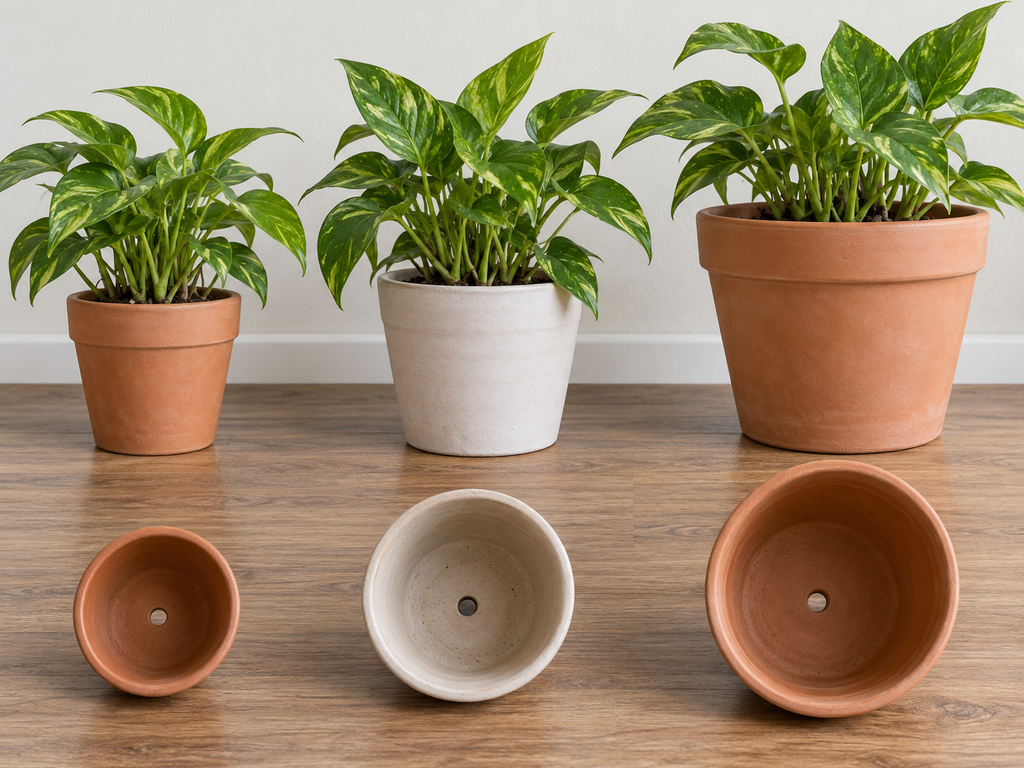
No.
A larger pot is appropriate when healthy roots have filled the current space and continued plant growth is desired.
Use the same pot when:
- the plant is already the size you want;
- the container is still suitable;
- the main problem is old potting mix;
- roots can be managed without more space.
Consider a smaller pot when substantial root loss means the existing container now holds far more growing medium than the remaining roots can use.
Container size should match the healthy root system that exists now, not the size you hope the plant may reach years later.
How Much Bigger Should the New Pot Be?
For many small and medium houseplants, moving up about one pot size or roughly 1–2 inches wider in diameter is usually enough.
The purpose is to provide additional root room without surrounding a relatively small root system with too much unused potting mix.
Oversized pots can stay wet longer because there are fewer roots relative to the volume of soil.
A plant growing in a 4-inch pot rarely needs to jump directly into a 10-inch planter.
Large established plants may need a somewhat larger increase, but the principle remains the same: move up gradually rather than dramatically.
For most houseplants, the new pot should also have functional drainage holes.
A decorative cachepot is fine when the plant stays in a draining inner pot and collected water is emptied after watering.
Best Soil for Repotting Indoor Plants
Most houseplants should be repotted into a potting medium formulated for containers rather than ordinary garden soil.
Healthy roots require both moisture and oxygen, so a good mix should retain enough water for the plant while still allowing excess moisture to drain and air to remain around the roots.
Common potting-mix components include:
- bark;
- coir;
- peat or peat alternatives;
- perlite;
- vermiculite.
Different plants need different balances.
Many tropical foliage plants grow well in a general indoor potting mix.
Succulents and cacti usually benefit from a faster-draining medium.
Many orchids require a much coarser, highly aerated mix.
African violets are commonly grown in lighter specialty mixes.
Do not automatically remove every trace of old potting mix during routine repotting. Healthy material can remain around intact roots unless there is a reason to remove it, such as severe compaction, decay, contamination, or waterlogging.
You also do not need a layer of rocks or gravel at the bottom of the pot.
Good drainage comes from:
appropriate potting mix + drainage holes + correct pot size + proper watering.
Repot Plants Wet or Dry?
For routine repotting, the root ball should generally be moist but well drained.
Very dry potting mix can crumble away and make fine roots easier to damage. Heavily saturated soil can be difficult to work with and may already indicate a moisture problem.
If the plant is very dry, water it beforehand and allow excess water to drain.
If the plant is waterlogged, do not add more water simply because general repotting advice says to water first.
Root-rot situations require different handling.
For a healthy plant, think:
moist and drained, not bone-dry or saturated.
Should You Water After Repotting?
For most healthy houseplants, yes.
Water thoroughly after repotting and allow excess moisture to drain. This helps settle the fresh growing medium around the roots.
After that first watering, do not keep the pot permanently wet.
The new container may dry more slowly than the old one, especially if it is larger.
A plant that previously needed water every four days may no longer need the same schedule after repotting.
Check actual moisture rather than watering automatically.
If the plant was repotted because of serious root damage, adjust watering to the condition of the healthy roots that remain.
How Long Does Repotting Shock Last?
Some plants show mild stress after repotting, especially when their roots have been disturbed.
Temporary drooping, reduced growth, or a brief pause in new leaves can happen while the root system adjusts.
Minor stress may improve within roughly a week or two, while fuller root establishment can take several weeks.
Recovery varies with:
- plant species;
- root disturbance;
- root health;
- season;
- temperature;
- light;
- watering.
The important question is not whether the plant looks perfect on a specific day.
Ask whether it is gradually stabilizing or progressively declining.
Avoid rushing to fertilize immediately after repotting, particularly if the new potting mix already contains nutrients.
Is Your Plant Recovering After Repotting?
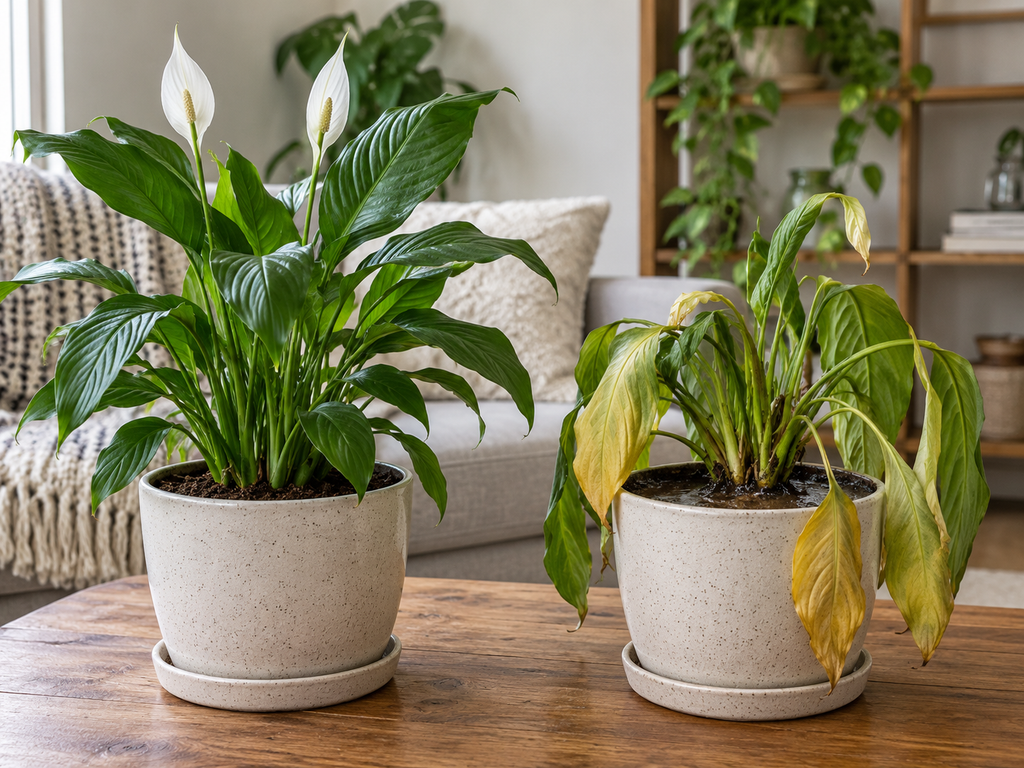
A recovering plant should gradually become more stable.
Mild short-term drooping or a temporary pause in growth is less concerning when symptoms stop getting worse.
Warning signs include:
- rapidly increasing yellowing;
- severe or worsening wilt;
- soft stems near the soil line;
- foul-smelling potting mix;
- soil remaining saturated unusually long;
- progressive tissue collapse.
If the plant looks worse, check:
- soil moisture;
- drainage;
- container size;
- planting depth;
- root condition;
- light;
- temperature.
Do not automatically respond with more water or fertilizer.
A stable or improving trend is more important than one imperfect leaf.
Why Do Plants Struggle After Repotting?
Plants often struggle because the new root environment is unsuitable, not simply because “repotting shock” is unavoidable.
Common causes include:
- a pot that is too large;
- dense or unsuitable potting mix;
- unnecessary root damage;
- planting too deeply;
- poor drainage;
- excessive watering;
- immediate heavy fertilizing;
- changing several environmental conditions at once.
If the soil stays wet far longer than before, check whether the new pot is oversized or the mix is too dense.
If the plant wilts while the soil is wet, do not assume it needs more water. Damaged or poorly aerated roots may be unable to absorb moisture properly.
If several leaves yellow progressively, inspect the root environment before adding fertilizer.
If growth simply pauses while the plant otherwise remains stable, monitoring may be more appropriate than another intervention.
When problems appear after repotting, troubleshoot what changed before repotting again.
How to Repot Without Root Problems
Once you know the plant genuinely needs repotting, keep the process simple.
1. Choose the correct pot
If moving up, select a container only modestly larger than the current one and make sure it drains.
2. Prepare the potting mix
Use fresh medium appropriate for the plant.
Do not add a gravel drainage layer.
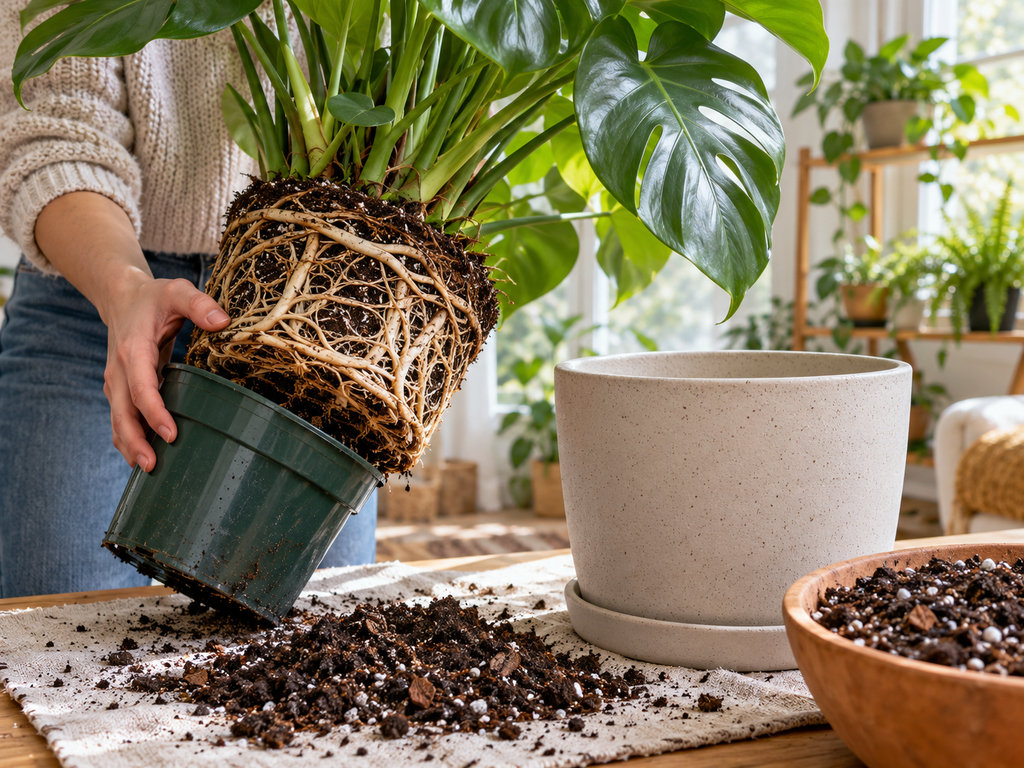
3. Remove the plant carefully
Support the plant near its base and gently release the root ball.
Avoid pulling hard on stems or leaves.
4. Inspect the roots
Look for dense circling roots, healthy firm roots, damaged tissue, and signs of decay.
Loosen severe circling roots carefully where appropriate.
5. Keep the same planting depth
Position the plant at approximately the same depth it occupied previously.
Avoid burying stems or crowns unnecessarily.
6. Fill around the roots
Add fresh growing medium around the root ball and lightly firm it without compressing it into a dense mass.
7. Water appropriately
For routine repotting, water thoroughly and allow free drainage.
8. Keep aftercare stable
Return the plant to suitable light and avoid unnecessary changes while the roots adjust.
The safest repotting strategy is usually the smallest effective intervention.
FAQs About When to Repot Indoor Plants
How do I know if my indoor plant needs repotting?
Look for dense circling roots, very little loose potting mix, rapid drying, and heavy root growth through drainage holes. Several signs together provide stronger evidence than one symptom alone.
Is one root coming out of the drainage hole enough to repot?
No. One visible root means you should inspect the root ball. Repot when roots are genuinely crowded and little usable potting mix remains.
What month is best to repot indoor plants?
Spring is usually easiest because many plants are entering active growth. For global growers, the plant’s actual growth activity matters more than a specific month.
How often should indoor plants be repotted?
There is no fixed schedule. Fast-growing plants may need more frequent attention, while slow-growing or mature plants can remain in the same pot much longer.
Can you repot houseplants in winter?
Yes when there is an urgent root or drainage problem. Healthy slow-growing plants can usually wait until stronger growth resumes.
Should I repot a plant immediately after buying it?
Usually not. Allow a healthy plant time to acclimate unless severe root congestion, drainage problems, or unhealthy roots require earlier action.
Does repotting always mean using a bigger pot?
No. A plant can be repotted into the same container with fresh growing medium. A larger pot is needed only when healthy roots genuinely need additional space.
Should plants be wet or dry before repotting?
For routine repotting, aim for a root ball that is moist but well drained. Avoid both completely dry and heavily waterlogged conditions.
Should I water immediately after repotting?
Usually, yes. Water thoroughly, allow excess moisture to drain, and wait until the growing medium reaches the appropriate moisture level before watering again.
Can a pot be too big after repotting?
Yes. An oversized pot contains more growing medium, which can stay wet longer than the root system can use safely.
Should I fertilize immediately after repotting?
Usually not. Give disturbed roots time to establish before returning to routine feeding, especially if the fresh potting mix already contains nutrients.
What is the biggest repotting mistake?
One major mistake is assuming every struggling plant needs a bigger pot. First determine whether the real problem is root space, potting mix, drainage, or root health.
What to Check Before Repotting
Before repotting an indoor plant, ask five questions.
Are the roots genuinely crowded?
Inspect the root ball rather than relying on one visible root.
Is the potting mix failing?
Old or compacted medium may need refreshing without requiring a larger pot.
Could another problem explain the symptoms?
Check light, moisture, pests, temperature, and root health.
Does the plant need a bigger pot, the same pot, or a smaller rescue container?
Match the container to the healthy root system.
Can the plant recover under its current conditions?
Consider light, temperature, active growth, and water use.
The best time to repot an indoor plant is when its root environment genuinely needs intervention and the chosen change solves that specific problem.
Diagnose first, make the smallest effective change, repot carefully, and monitor recovery.
Myra is the founder and lead writer of Plantsaholic. She shares practical, research-backed advice on indoor plants, outdoor gardening, flowers, herbs, succulents, and everyday plant care. Her goal is to help gardeners of all experience levels grow healthier plants through simple, easy-to-follow gardening guides.