A pebble tray for plants is a shallow waterproof container filled with stones and a little water, with the plant pot held above the waterline. Evaporation adds moisture to nearby air, although the effect around foliage may be too small to measure.
A tray is inexpensive and quiet, but cannot replace correct care or a humidifier in very dry rooms. This Plantsaholic guide covers safe setup, maintenance, and testing.
| Quick question | Practical answer |
|---|---|
| Do pebble trays raise humidity? | They add water vapor, but plant-level effects may be small. |
| Can one humidify an entire room? | Not reliably. |
| Should the pot touch water? | No; keep drainage holes above the reservoir. |
| Which stones are best? | Clean, stable, washable pebbles. |
| How can you judge success? | Compare hygrometer readings under similar conditions. |
| When is a humidifier better? | When a larger, sustained humidity increase is needed. |
Do You Need a Pebble Tray?
Consider a pebble tray when a plant prefers relatively humid air, the surrounding room is dry, and its other growing conditions are suitable. Not every houseplant needs one.
Brown tips or curling leaves may also indicate watering, fertilizer salts, drainage, or root problems.
Use this short checklist:
- Species: Does the plant naturally prefer moderate or high humidity?
- Room: Does a hygrometer confirm that the air is drier than the plant needs?
- Soil: Is the potting mix drying or remaining wet at an appropriate rate?
- Location: Is the foliage directly beside a heater, fan, or air-conditioning vent?
- Container: Can the pot stand securely above water without blocking drainage?
If humidity is suitable, skip the tray. For other diagnoses, see brown leaf tips.
Also remember that air humidity and soil moisture are separate measurements. A damp tray cannot compensate for a potting mix that has dried beyond what the species tolerates, and increasing soil watering cannot necessarily resolve dry surrounding air.
What Humidity Level Do Plants Need?
There is no single correct relative-humidity level for every houseplant. Iowa State University Extension notes that many houseplants prefer about 40–50% relative humidity (RH). Certain tropical species need more, while many succulents tolerate considerably less.
Relative humidity also changes with temperature. Measure near the leaves under normal household conditions.
| Indoor reading | Practical response |
|---|---|
| 40–50% RH, healthy plant | Extra humidity may be unnecessary. |
| 30–40% RH, sensitive tropical plant | Review care and test a tray if the deficit is mild. |
| Below 30% RH, demanding plant | Consider stronger, controlled humidity support. |
| Above 60% RH | Confirm plant requirements and check for moisture problems. |
These are decision examples, not universal targets; the Royal Horticultural Society describes species preferring around 60% RH or higher.
Should You Humidify the Whole Room?
Not necessarily. One plant’s humidity needs may exceed what’s appropriate for a living room. The US EPA advises keeping household humidity below 60%, preferably around 30–50%, to reduce moisture-related problems.
For plants with unusually high requirements, an appropriate terrarium or ventilated plant cabinet may be more practical. Explore other approaches in how to increase humidity for plants.
What Is a Pebble Tray for Plants?
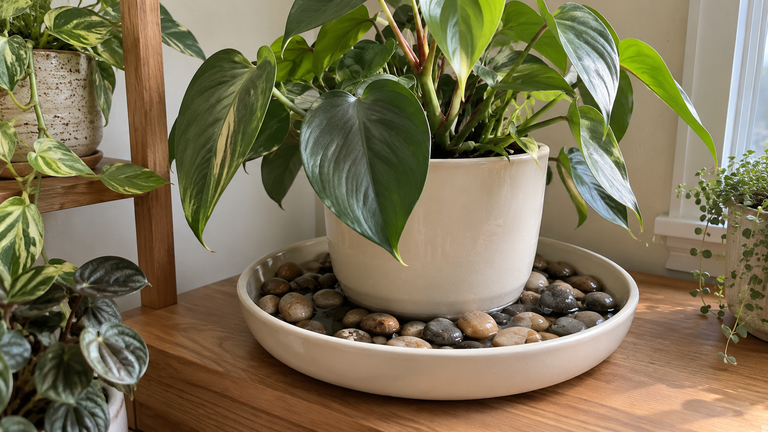
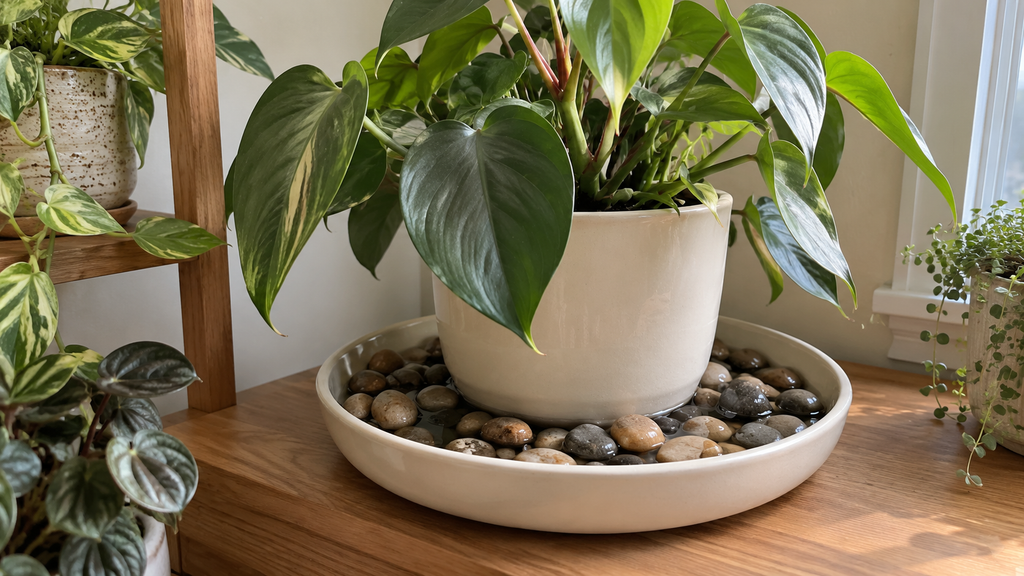
A pebble tray, sometimes called a humidity tray, gravel tray, or humidity saucer, is a non-draining container holding a layer of pebbles and shallow water. The pot rests on the stones rather than in the reservoir.
Its structure is straightforward: waterproof tray → supporting stones → exposed water → elevated pot. The stones provide stability and separation; evaporation supplies the water vapor.
Unlike a self-watering planter, a humidity tray must not continuously wet the soil. A sufficiently wide, waterproof saucer can work.
How Do Pebble Trays Work?
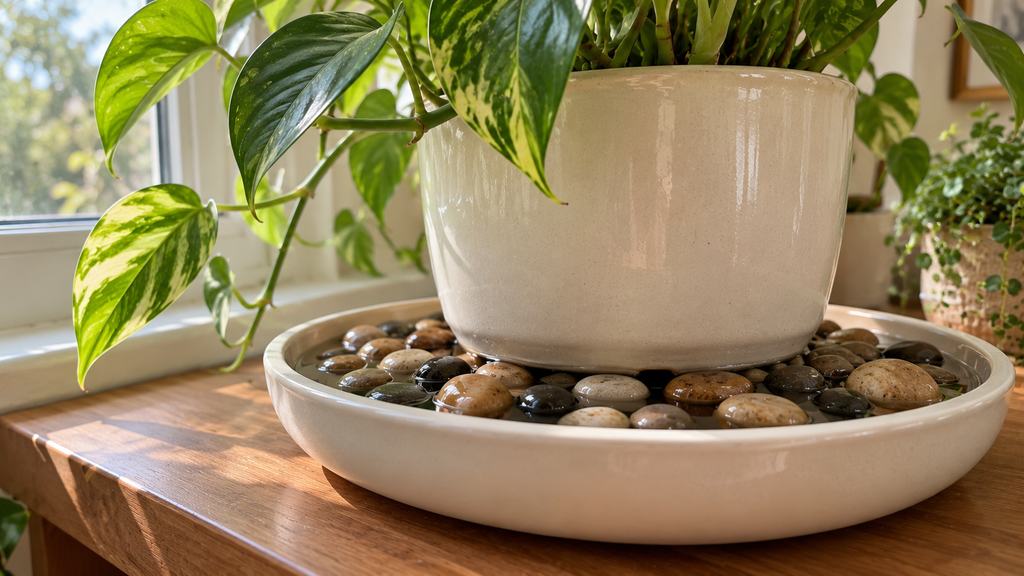
Water molecules escape from the open reservoir into the air through evaporation. Pebbles are not themselves a humidity source. Their job is to elevate the pot and leave spaces through which water can evaporate.
Results depend on exposed water area, temperature, airflow, and foliage height. Wider trays usually leave more water exposed.
Strong airflow may accelerate evaporation while dispersing moisture. Tall plants above tiny trays are therefore poor candidates.
This explains why identical trays can behave differently on a crowded plant shelf, an open windowsill, and a table beside a ceiling fan. Consider the space around the whole plant, not just the reservoir’s dimensions.
Water disappearing is evidence of evaporation, not proof of improved growing conditions. Measure the air near the leaves if the result matters.
Do Pebble Trays Really Work?
Pebble trays do evaporate water, but their practical effect on humidity can be limited. There is no credible universal figure such as “one tray adds 10% humidity.” Results differ among rooms, tray sizes, plant heights, and ventilation patterns.
Iowa State University Extension recommends pebble trays as one possible way to increase moisture around houseplants. However, vapor disperses through an open room, so local improvement is not guaranteed.
Try broad trays beneath compact leaves for mild dryness. Use a humidifier for reliable room-wide control.
The most defensible answer is to test your own setup rather than expecting a fixed percentage or judging success by how fast the tray empties.
Will a Pebble Tray Work for You?
Tray width, canopy height, placement, and airflow also matter.
| Your setup | Assessment | Recommended action |
|---|---|---|
| Small foliage, wide tray, gentle airflow | Better candidate | Try it and measure. |
| Several compatible compact plants | Reasonable supplemental option | Keep pots stable and air circulating. |
| Large floor plant, narrow saucer | Poor candidate | Use a more effective humidity method. |
| Directly beside an AC or heater vent | Unfavorable | Change placement first. |
| Already humid room | Probably unnecessary | Monitor without adding water. |
How Far Does a Tray Reach?
There is no established “humidity bubble” radius; vapor mixes with moving air.
Measure at leaf height, away from sun and splashes, not directly on wet stones.
Which Plants Benefit From Pebble Trays?
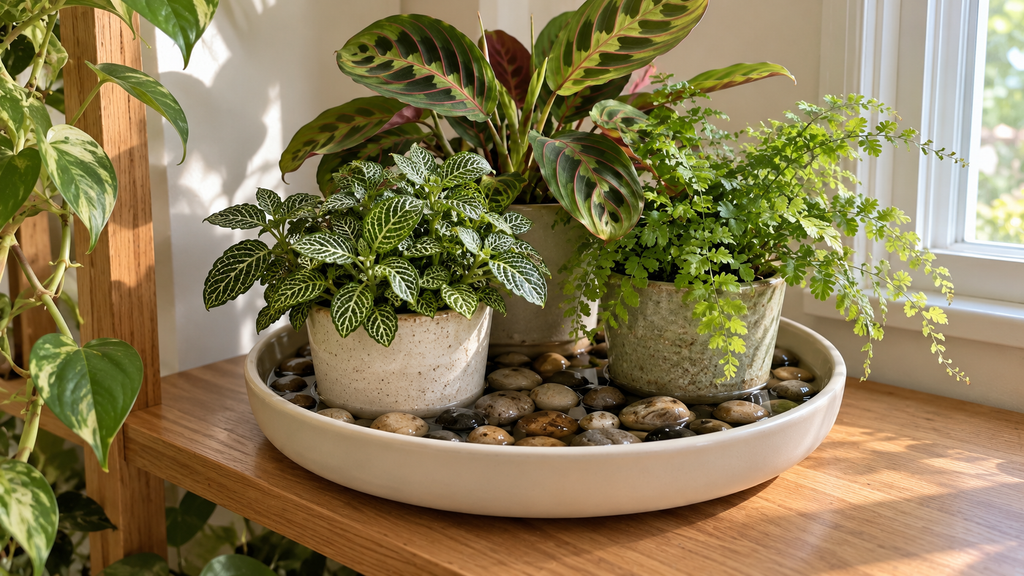
Plants that appreciate humid conditions and have foliage close to the tray are reasonable candidates, especially when a room is mildly dry. Examples include Fittonia, prayer plants (Maranta), many plants sold as Calathea (Goeppertia), Stromanthe, small tropical ferns, Rex begonias, some orchids, and young Alocasia.
These preferences do not guarantee a tray will help. Even humidity-loving plants need no extra moisture in an adequately humid room.
Most desert cacti and drought-adapted succulents need no extra humidity. Maintain airflow around orchids.
Choose according to the species and its actual environment, not whether the leaves look tropical.
Where several plants have different humidity requirements, avoid treating them as one group. A fern that enjoys moist air and a drought-tolerant succulent may share a room, but they should not automatically receive the same humidity intervention.
Which Pebbles Are Best?
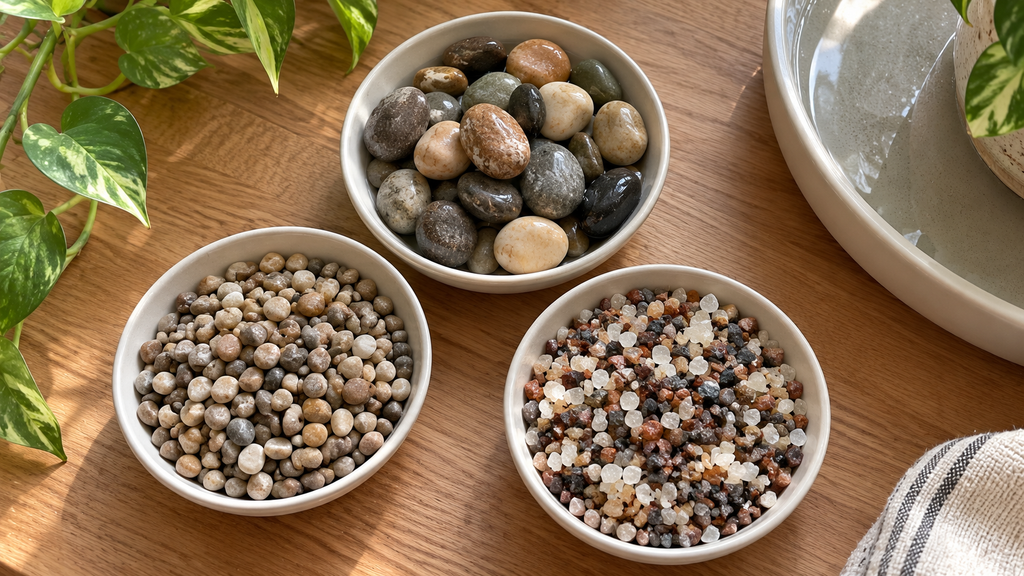
The best stones are clean, stable, non-crumbling, and easy to wash. Their color and price matter less than whether the pot stays steady and the stones keep its drainage holes above water.
| Material | Advantage | Consideration |
|---|---|---|
| Pea gravel | Affordable and widely available | Small pieces trap debris. |
| River pebbles | Reusable and decorative | Rounded stones may shift. |
| Aquarium gravel | Suitable for compact trays | Rinse dust and inspect stability. |
| Washed gravel | Practical and inexpensive | Avoid sharp, dirty fragments. |
| LECA clay balls | Lightweight | Some pieces move or float. |
Rinse stones before use. Reject crumbling materials and test heavy pots on dry stones for stability.
What Size Pebble Tray Do You Need?
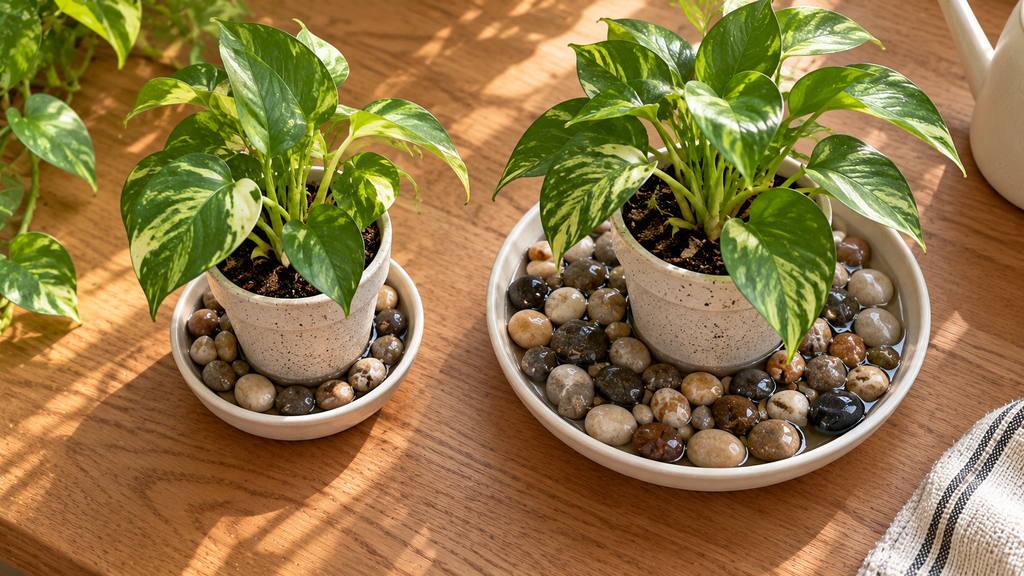
Choose a tray wider than the pot, leaving exposed water around its footprint. Added width generally increases the potential evaporation area; adding extra depth mainly increases water storage and weight.
For an eight-inch-diameter circular pot, compare these illustrative tray sizes:
| Circular tray diameter | Area outside pot footprint |
|---|---|
| 9 inches | About 13 square inches |
| 10 inches | About 28 square inches |
| 12 inches | About 63 square inches |
These are geometric estimates, not humidity gains; stones reduce actual exposed water.
To compare trays fairly, measure the footprint where water can remain visible around the pot. A wide tray packed tightly with stones may expose less water than its dimensions initially suggest. Stability still takes priority over maximizing surface area.
How Do You Choose a Safe Tray?
Use a leakproof tray deep enough to raise the pot above water and strong enough for the combined weight.
Do Small Pebble Trays Work?
Small trays suit compact plants but have limited area and may dry quickly. Refill without submerging drainage holes.
How Do You Make a Pebble Tray for Plants?
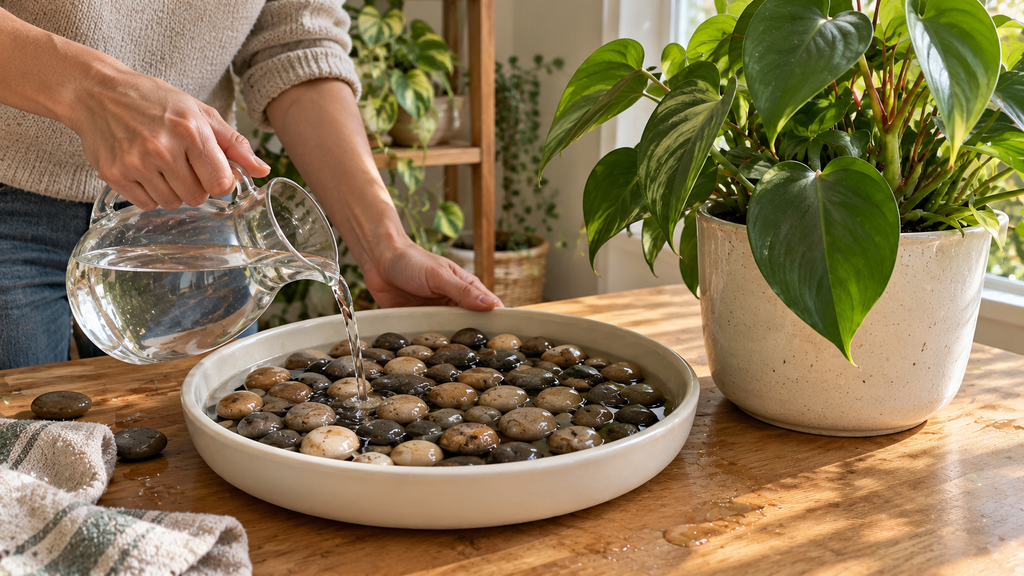
You need a shallow waterproof tray, clean pebbles, water, and a potted plant. A hygrometer helps assess results.
1. Choose the Tray
Use a broad, leakproof tray that will fit securely on its intended surface. Avoid unstable or cracked containers.
2. Wash the Pebbles
Rinse away dust, soil, and loose fragments. Clean stones are easier to maintain later.
3. Add the Stone Layer
Spread enough stones to elevate and support the pot. Level the surface rather than creating a wobbly mound.
4. Test the Pot
Set the pot on the dry pebbles. Check its stability from several angles before adding water.
5. Add Water
Pour water slowly between the lower stones. Leave the upper surfaces exposed and stop below the pot base.
6. Check the Waterline
Look from the side. Ensure the drainage holes never touch standing water, including after stones settle.
7. Position the Plant
Return the plant to appropriate light and temperature, away from direct heated or cooled airflow.
8. Monitor the Setup
Check water, cleanliness, and stability regularly.
How Do You Use a Pebble Tray?
Maintain shallow water below the plant pot and refill it as needed. Check the reservoir during ordinary plant-care routines, but keep tray maintenance separate from watering the soil.
Plant watering manages root-zone moisture. Pebble-tray water evaporates into the air. The potting mix can need irrigation while the tray remains full, or the tray can run dry while the soil is still moist.
When watering the plant from above, move it to a sink or separate drainage dish if possible. Let surplus irrigation water drain before returning the pot. This prevents fertilizer-rich runoff from collecting in the humidity reservoir.
Several small plants can share a broad tray if their pots remain level and do not obstruct cleaning. Preserve some airflow between leaves, especially for plants susceptible to fungal leaf spots.
Use a waterproof mat when displaying trays on wood or painted furniture. Check underneath during cleaning; unnoticed condensation and spills can damage a shelf even when the water level inside the tray is correct.
Check daily for low water, stability, and leaks.
Why Keep Plant Pots Above Water?
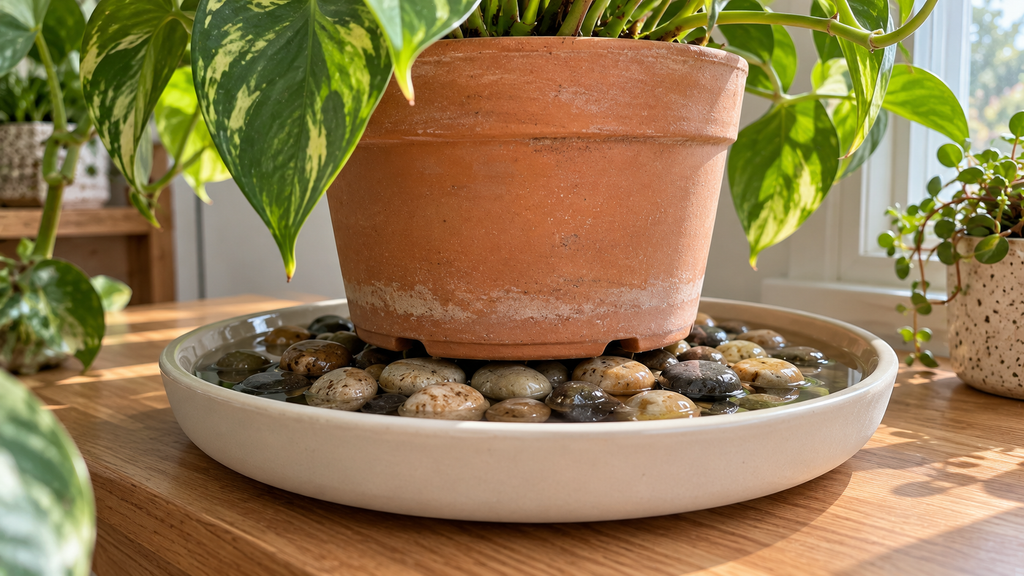
The pot must remain above water so the humidity tray does not continuously wet the growing medium. Saturated potting mix restricts oxygen around roots and can contribute to root decline and rot.
If a pot rests in the reservoir, moisture may enter through its drainage holes. Depending on the potting mix, that can lead to yellowing lower leaves, wilting despite wet soil, or unusually slow drying. Inspect roots rather than assuming a diagnosis.
A humidity tray and bottom watering are different techniques. Bottom watering deliberately places a pot in water temporarily, after which it is removed and drained. A pebble tray keeps the pot above water continuously.
If the reservoir touches the pot, remove water or adjust the support immediately. For intentional bottom watering, follow a separate bottom-watering guide.
Can Pebble Trays Hold Drainage Water?
Fresh water is preferable to leftover irrigation runoff. When water drains through fertilized potting mix, it may carry dissolved salts and soil particles into the tray. Those materials remain as the water evaporates and can form deposits.
NC State Extension warns that fertilizer-rich runoff can be reabsorbed if a pot contacts the saucer water, potentially damaging roots.
How Do You Prevent Salt Buildup?
Water and fertilize over a sink or separate container when practical. Allow the pot to finish draining, empty accidental runoff, and refill the pebble tray with fresh water. Rinse away visible mineral crust when cleaning.
Tap water usually works, although hard water leaves deposits. Never add fertilizer to the humidity reservoir.
Why Isn’t Your Pebble Tray Working?
Even correctly assembled trays may be ineffective in ventilated or very dry rooms. Diagnose the cause before adding water.
| What you notice | Possible explanation | Better response |
|---|---|---|
| Tray empties; leaf edges remain brown | Humidity change is insufficient, or dryness has another cause | Measure RH; check roots and watering. |
| Hygrometer barely moves | Limited exposed area or rapid air mixing | Try a broader tray or different method. |
| Soil stays wet | Drainage holes contact water | Raise the pot and inspect the mix. |
| Tall plant shows no improvement | Leaves are far above the reservoir | Assess at leaf height; consider a humidifier. |
| Water smells or turns cloudy | Debris and inadequate cleaning | Empty and scrub the tray. |
Old brown tissue cannot recover. Monitor new growth while checking other care factors.
How Often Should You Clean Pebble Trays?
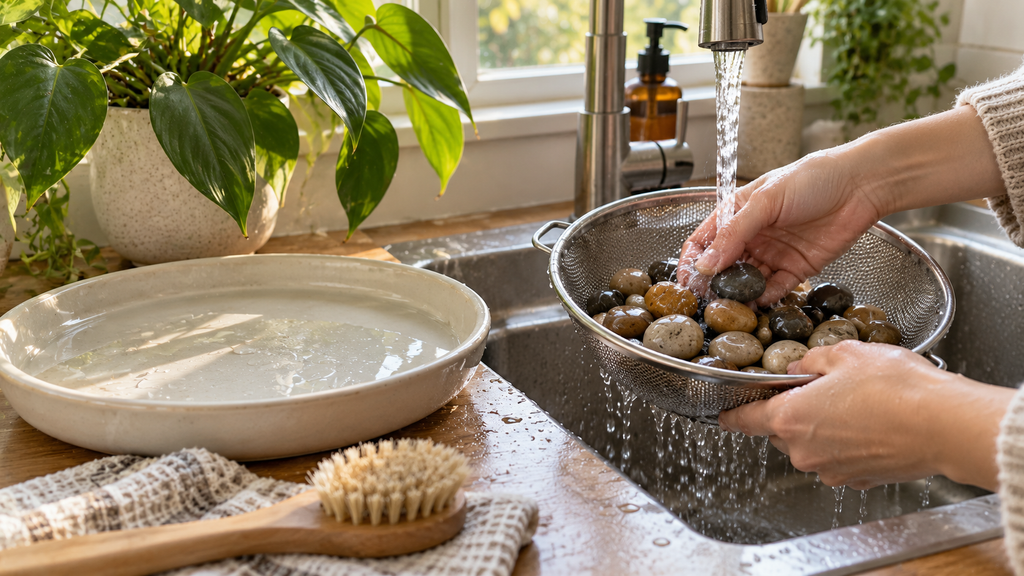
Empty and scrub a pebble tray at least once a week, and sooner if the reservoir becomes cloudy, slimy, or dirty. The CDC recommends weekly cleaning of water-holding items, including flowerpot saucers, to discourage mosquitoes.
How Do You Clean One?
Remove the plant, pour out the water, and take out the stones. Scrub the tray and rinse the pebbles, using mild dish soap if necessary. Rinse away all residue before reassembling. Replace the plant and refill below its base.
If white mineral crust persists, scrub it during routine cleaning rather than allowing repeated layers to build. Discard stones that have deteriorated or cannot be cleaned adequately, and inspect the tray for cracks before refilling.
Can Pebble Trays Attract Mosquitoes?
Yes. Mosquitoes that reach neglected standing water may breed there. In mosquito-active areas, ensure window screens are intact and clean reservoirs consistently. Refilling alone does not clean the tray.
Can Pebble Trays Cause Mold?
Spills and trapped moisture can promote dampness. Protect shelves and investigate condensation.
Does Climate Affect Pebble Trays?
Yes, but actual indoor humidity matters more than outdoor weather. Central heating can dry winter air; heavy air-conditioning can reduce indoor moisture even in tropical climates. Open windows and fans may disperse water vapor before it reaches foliage.
| Home environment | Practical decision |
|---|---|
| Heated home in winter | Check RH before adding a tray. |
| Hot region with frequent AC | Avoid direct vents; measure near leaves. |
| Naturally humid home | Extra evaporation may be unnecessary. |
| Very dry climate | Consider a humidifier for demanding plants. |
| Frequently ventilated room | Expect variable readings and repeat tests. |
Recheck RH as heating or cooling patterns change.
Which Plant Humidity Method Works Best?
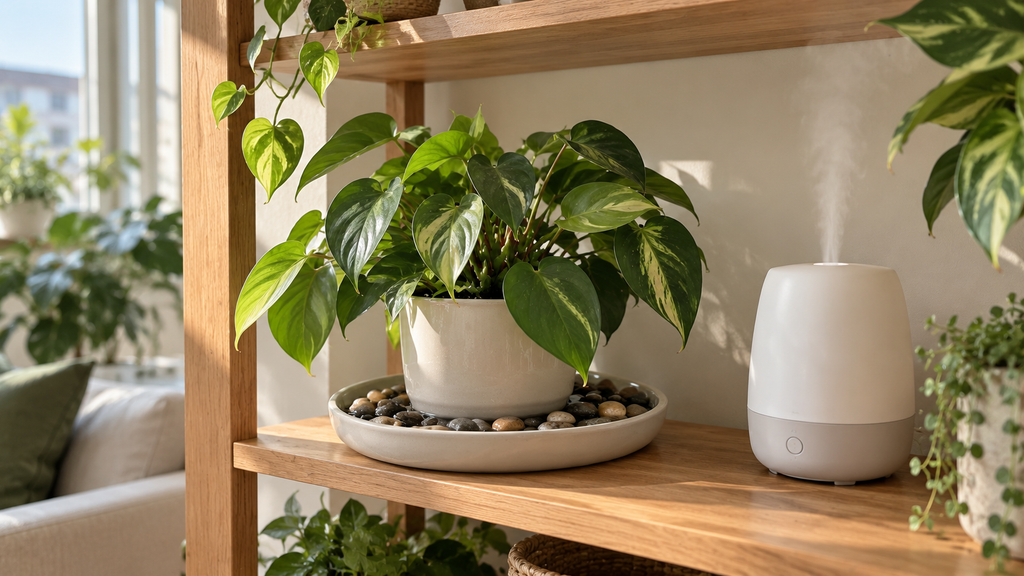
Choose the least complicated method that can meet the plant’s actual humidity requirement. Pebble trays may offer modest local support, while other approaches are better for sustained control.
| Method | Main strength | Limitation |
|---|---|---|
| Pebble tray | Quiet, inexpensive, electricity-free | Small, variable effect |
| Plant grouping | Easy local microclimate | Limited in open rooms |
| Misting | Briefly wets foliage | Does not maintain RH |
| Terrarium or plant cabinet | More controlled environment | Requires appropriate ventilation |
| Humidifier | Can raise room humidity consistently | Needs cleaning and monitoring |
For large deficits, use a maintained humidifier while monitoring RH. A suitable enclosure can serve individual demanding plants.
How Can You Test a Pebble Tray?
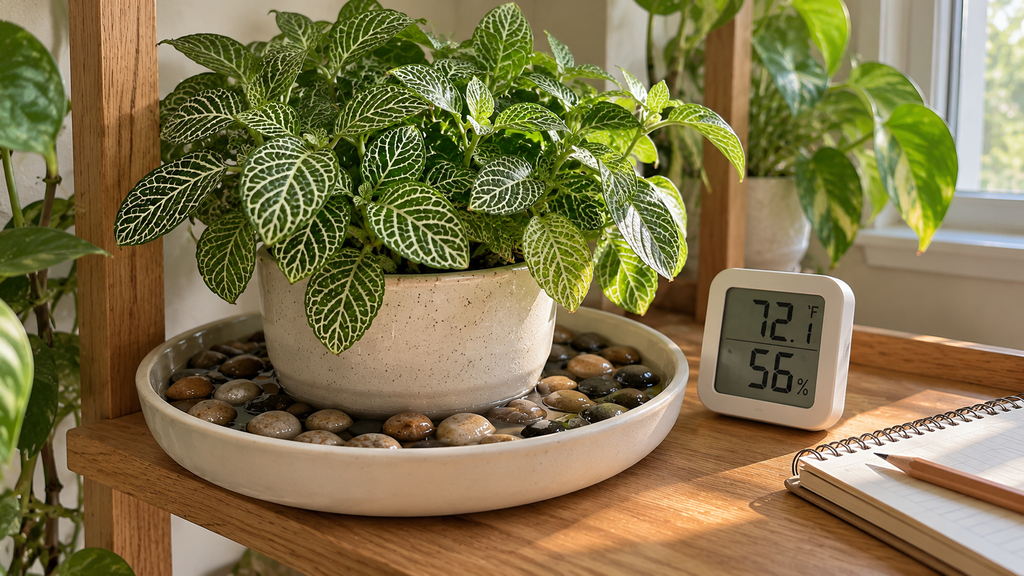
A repeatable home comparison is better than guessing, though it is not laboratory-grade evidence.
Step 1: Record a Baseline
Keep the plant in its usual position. For two days, record humidity at leaf height in the morning and evening. Note temperature, open windows, heating, and AC use.
Step 2: Install the Tray
Set up the tray correctly without moving the plant to a different location. Keep the hygrometer away from wet stones and direct sunlight.
Step 3: Measure for Several Days
Record readings at similar times for another three to five days. A second sensor elsewhere in the room helps identify general changes unrelated to the tray.
Use the same instrument positions throughout the comparison. If one hygrometer consistently reads higher than the other when placed side by side, note that offset before treating later differences as a tray effect.
| Observation | Near leaves RH | Elsewhere RH | Temperature |
|---|---|---|---|
| Baseline day 1 | ___ | ___ | ___ |
| Baseline day 2 | ___ | ___ | ___ |
| With tray day 1 | ___ | ___ | ___ |
| With tray day 3 | ___ | ___ | ___ |
| With tray day 5 | ___ | ___ | ___ |
Step 4: Interpret the Difference
If both readings rise, room conditions may explain the change. Differences below sensor accuracy are inconclusive.
Step 5: Observe New Growth
Watch new foliage over subsequent weeks while keeping other care consistent. These are suggested steps, not claimed Plantsaholic test results.
When Should You Skip a Pebble Tray?
Skip the tray if the room already meets the plant’s requirements or if the plant naturally tolerates dry air. It will not solve root damage, wet soil, or unsuitable light.
Avoid unstable, leaky, or neglected trays. Demanding plants may need stronger control.
Ask three questions: Does the plant benefit from additional humidity? Is the room actually dry? Can the pot stay safely above water? If any answer is no, address that issue first.
What Are Common Pebble Tray Questions?
Do Pebble Trays Really Increase Humidity Around Plants?
Evaporation adds water vapor, but the increase near leaves is often small. One tray cannot reliably humidify a whole room.
How Much Humidity Can a Pebble Tray Add?
There is no guaranteed percentage. Measure leaf-height RH under comparable conditions instead of relying on generalized claims.
Should the Plant Pot Touch the Water in a Pebble Tray?
No. Keep its base and drainage holes above water to prevent prolonged saturation of the potting mix.
How Much Water Should You Put in a Pebble Tray?
Add shallow water between the lower stones, stopping below the pot base. Refill when needed without overfilling.
Which Houseplants Benefit Most From Pebble Trays?
Compact humidity-loving plants, including Fittonia, Maranta, and small tropical ferns, are reasonable candidates when indoor air is dry.
Can a Pebble Tray Fix Brown Tips on Calathea or Prayer Plants?
It might reduce future damage if dry air is responsible. Existing brown tissue cannot recover; investigate watering and mineral buildup too.
How Often Should You Refill and Clean a Pebble Tray?
Refill as water evaporates. Empty and scrub the reservoir at least weekly, or sooner when visibly dirty.
Can Pebble Trays Cause Root Rot, Mold, or Mosquitoes?
Problems arise when pots touch water, surfaces stay damp, or reservoirs are neglected. Maintain a low waterline and clean regularly.
Can a Pot Without Drainage Holes Sit on a Pebble Tray?
Yes, but the tray will not correct trapped water inside that pot. A draining nursery pot is easier to manage.
Are Pebble Trays Better Than Humidifiers or Misting?
No for room-wide control. Trays provide limited evaporation, misting is temporary, and humidifiers can deliver sustained humidity.
Is a Pebble Tray Worth It?
A pebble tray for plants is worth trying for mild dryness when the pot stays above water. It is simple and inexpensive, not a guarantee of humidity improvement.
Use a broad stable tray, keep it clean, and measure near foliage. If RH remains low, consider a humidifier or enclosure. Healthy roots, light, and watering remain essential.
Myra is the founder and lead writer of Plantsaholic. She shares practical, research-backed advice on indoor plants, outdoor gardening, flowers, herbs, succulents, and everyday plant care. Her goal is to help gardeners of all experience levels grow healthier plants through simple, easy-to-follow gardening guides.