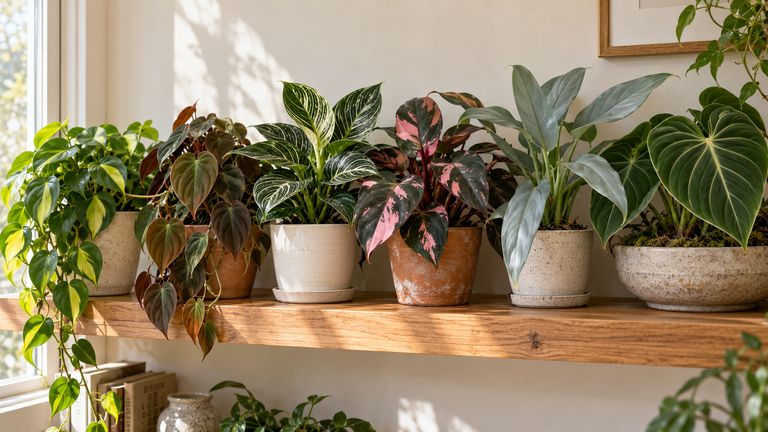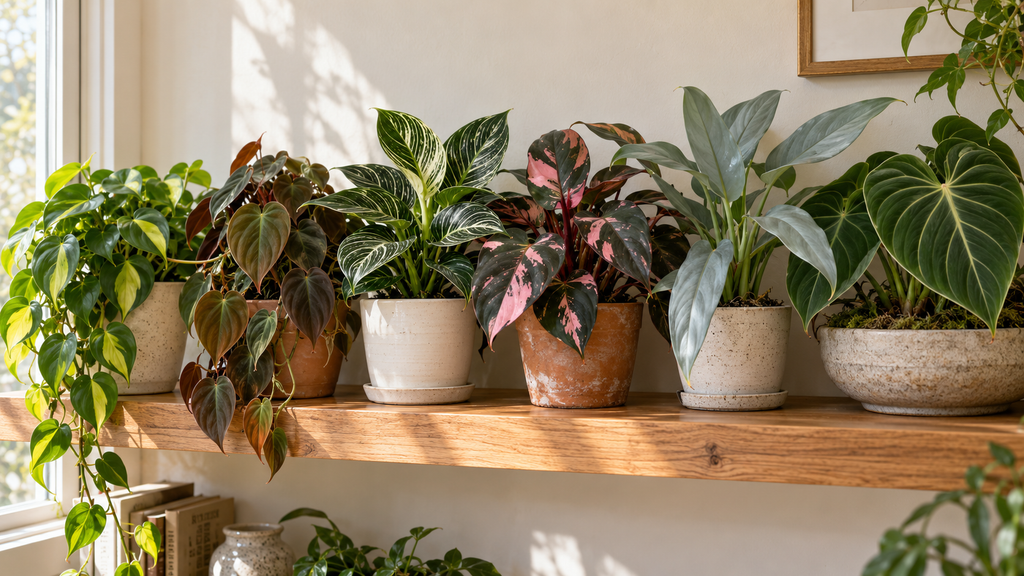
Philodendron varieties include trailing Heartleaf and Brasil, pinstriped Birkin, pink-variegated Pink Princess, and spectacular velvet-leaved Gloriosum. This guide compares 25 types by appearance, growth habit, space needs, and care.
| Variety | Growth Habit | Distinguishing Feature | Difficulty |
|---|---|---|---|
| Heartleaf | Climbing/trailing | Plain green hearts | Easy |
| Brasil | Climbing/trailing | Lime central stripe | Easy |
| Micans | Climbing/trailing | Bronze velvet leaves | Easy–moderate |
| Lemon Lime | Climbing/trailing | Chartreuse foliage | Easy |
| Birkin | Upright | Cream pinstripes | Easy–moderate |
| Pink Princess | Climbing | Pink variegation | Moderate |
| White Princess | Climbing | White markings, sometimes pink stems | Moderate |
| White Wizard | Climbing | Bold white sectors | Moderate |
| Prince of Orange | Upright | Orange new growth | Easy |
| Moonlight | Upright | Broad lime-green leaves | Easy |
| Rojo Congo | Upright | Burgundy-toned growth | Easy |
| Imperial Green | Upright | Broad glossy leaves | Easy |
| Silver Sword | Climbing | Metallic blue-silver leaves | Moderate |
| Gloriosum | Crawling | Velvet hearts, pale veins | Moderate |
| Melanochrysum | Climbing | Long dark velvet leaves | Moderate–advanced |
| Verrucosum | Climbing | Hairy petioles | Advanced |
| Billietiae | Climbing | Orange petioles | Moderate |
| Squamiferum | Climbing | Red bristly petioles | Moderate |
| Pedatum | Climbing | Deeply lobed leaves | Moderate |
| Mamei | Crawling | Silver mottling | Moderate |
| Sodiroi | Climbing | Silver patches | Moderate |
| Ring of Fire | Semi-upright/climbing | Serrated, multicolored leaves | Moderate |
| Florida Beauty | Climbing | Variegated lobed leaves | Moderate |
| Xanadu | Upright | Dense divided foliage | Easy–moderate |
| Spiritus-sancti | Climbing | Exceptionally narrow leaves | Advanced |
What Are Philodendron Varieties?
Philodendron is a tropical American genus in the arum family, Araceae. Its members differ in foliage, stem structure, and growth pattern. The Royal Botanic Gardens, Kew, currently recognizes 629 accepted species; nurseries also sell many hybrids and named cultivated selections. A nursery “variety” need not be a separate species.
Which Philodendron Names Are Botanically Correct?
Heartleaf is Philodendron hederaceum; Brasil is its cultivated selection ‘Brasil’. Silver Sword is P. hastatum, Gloriosum is P. gloriosum, and Spiritus-sancti is P. spiritus-sancti. Micans is commonly sold under that name but belongs within P. hederaceum in Kew’s treatment. Birkin and Pink Princess are horticultural selections rather than distinct wild species.
Xanadu is sometimes labeled Thaumatophyllum xanadu. Kew currently accepts Philodendron xanadu and treats the alternative combination as a synonym. Verify expensive plants beyond their labels.
What Are the Main Philodendron Types?
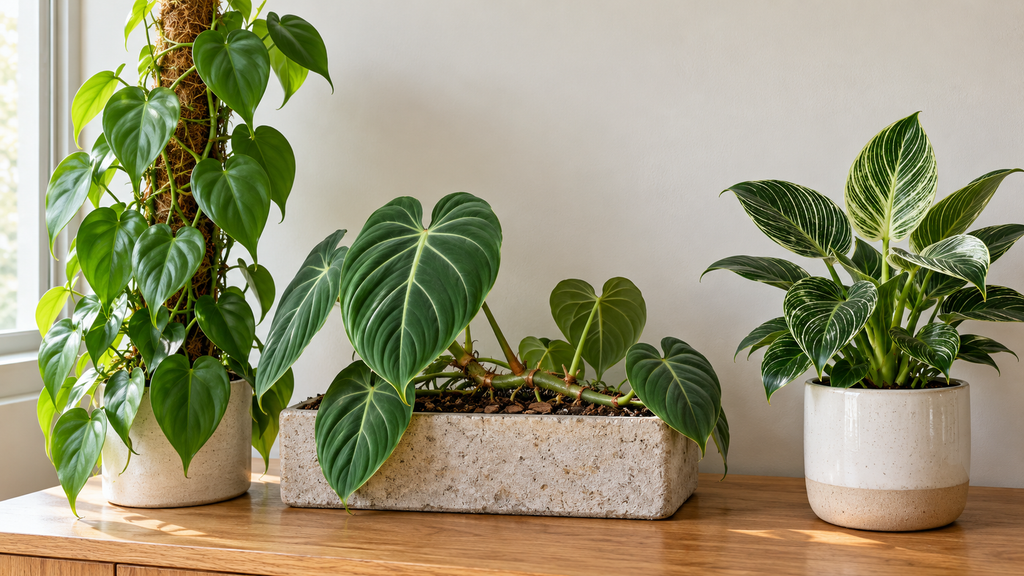
Climbers extend upward when given a pole, plank, or trellis. Silver Sword, Pedatum, and Melanochrysum may develop larger, more mature leaves with appropriate support.
Crawlers spread horizontally along the potting mix. Gloriosum and Mamei need wide containers that accommodate their creeping stems.
Upright or self-heading types form concentrated clusters of foliage instead of long vines. Birkin, Moonlight, Rojo Congo, and Prince of Orange fit this category, although mature leaves still need room.
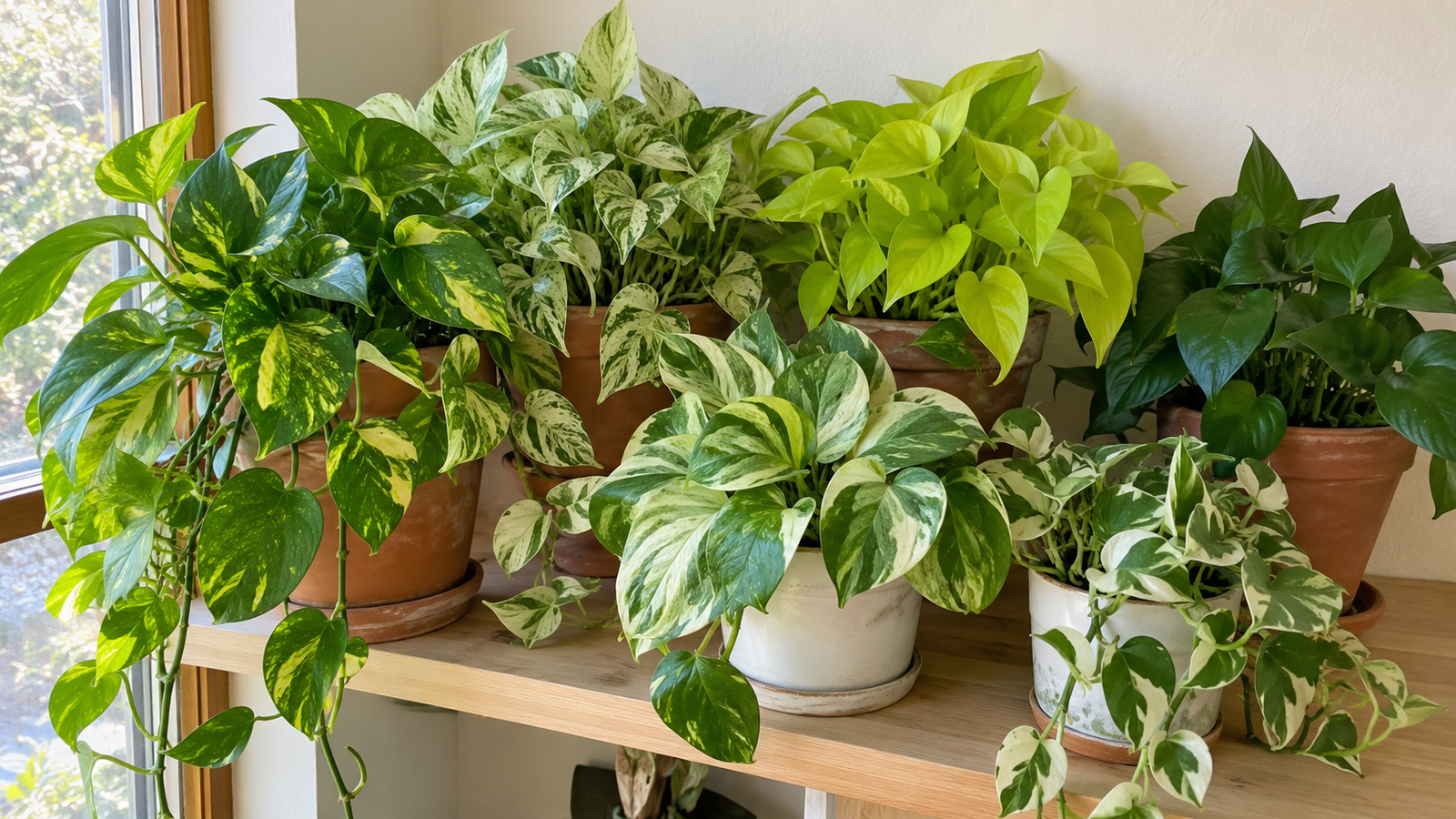
Trailing types are usually climbers grown without support. Heartleaf, Brasil, Micans, and Lemon Lime cascade naturally from baskets and shelves.
25 Best Philodendron Varieties
1. Heartleaf Philodendron
Botanical name: Philodendron hederaceum · Best for: Beginners
Heartleaf has smooth green, heart-shaped leaves on slender stems. It adapts to ordinary indoor humidity and tolerates medium light better than many colorful cultivars. Grow it trailing or direct aerial roots onto a support. Small leaves and widely spaced nodes may signal insufficient light.
2. Philodendron Brasil
Botanical name: P. hederaceum ‘Brasil’ · Best for: Easy color
Brasil looks like Heartleaf but carries lime or yellow-green streaks through its leaves. Each leaf’s pattern differs, so uneven coloring is normal. It trails attractively across shelves and is beginner-friendly. Provide bright indirect light, avoiding harsh sun.
3. Philodendron Micans
Botanical association: P. hederaceum · Best for: Velvet texture
Micans has soft-looking bronze-green leaves that can appear reddish in angled light. Unlike the glossy Heartleaf, its surface has a distinctive velvet sheen. It can trail or climb, making it useful for shelves and supports. Compare several leaves when identifying it.
4. Lemon Lime Philodendron
Best for: Bright trailing foliage
Lemon Lime produces chartreuse heart-shaped leaves on long vines. Its coloration is usually more uniform than Brasil’s central stripes. Use it in hanging baskets or on supports. A vine’s overall shape distinguishes it from similarly bright, self-heading Moonlight.
5. Philodendron Birkin
Best for: Compact-looking displays
Birkin produces glossy green leaves with irregular cream-white pinstripes. Young plants fit desks or side tables, but mature specimens can approach three feet in height and width. Some leaves emerge greener or develop unusual reddish growth. Prioritize strong roots and continued growth over perfect striping.
6. Pink Princess Philodendron
Best for: Pink variegation
Pink Princess combines green foliage with variable pink patches. New leaves may contain more or less pink than older ones; lighting alone cannot guarantee a particular pattern. Give this climber bright indirect light and vertical support. Avoid overwhelmingly pink specimens with little green tissue.
7. White Princess Philodendron
Best for: White variegation
White Princess has irregular white areas on green leaves and can show pinkish markings on its stems or petioles. Young plants are easily confused with White Wizard. Examine multiple nodes and leaf stalks rather than relying on one striking leaf. Mature stems may need support.
8. White Wizard Philodendron
Best for: Large white sectors
White Wizard develops green-and-white leaves, sometimes with substantial pale areas. Its stem is generally greener than White Knight’s darker burgundy growth. It climbs and benefits from a stable support. Favor healthy roots and balanced green foliage.
9. Prince of Orange Philodendron
Best for: Changing leaf colors
Prince of Orange produces coppery or orange new foliage that gradually turns greener. That change is normal maturation, not lost variegation. Its upright habit makes it easy to display without a pole, though broad leaves eventually need clearance. Compare new and older foliage.
10. Philodendron Moonlight
Best for: Lime-green upright foliage
Moonlight forms a concentrated cluster of broad, luminous yellow-green leaves. Unlike climbing Lemon Lime, it does not form long trailing stems. Its foliage brings contrast to a room filled with dark green plants. Allow room for mature leaves.
11. Rojo Congo Philodendron
Best for: Large floor displays
Rojo Congo has broad, glossy leaves and reddish or burgundy tones in new growth and supporting structures. It grows upright rather than producing a climbing vine. Mature specimens require floor space. Good drainage protects its relatively large root system.
12. Imperial Green Philodendron
Best for: Straightforward greenery
Imperial Green produces dense, glossy green foliage in a self-heading form. It offers an architectural appearance without difficult variegation requirements. The plant suits growers seeking reliable indoor greenery, provided the pot drains freely. Plan for broad mature leaves.
13. Silver Sword Philodendron
Botanical name: P. hastatum · Best for: Metallic color
Silver Sword has blue-silver leaves that stand apart from ordinary green Philodendrons. Its juvenile leaves are comparatively simple; supported mature growth may develop more elaborate shapes. Supply a pole or plank for climbing and brighter indirect light. Metallic color distinguishes juvenile plants.
14. Philodendron Gloriosum
Botanical name: P. gloriosum · Best for: Oversized velvet leaves
Gloriosum displays broad, velvety heart-shaped leaves crossed by pale veins. Its thick stem crawls across the soil rather than climbing upward. A long or wide planter prevents the growing tip from quickly reaching an edge. Do not bury its creeping stem deeply.
15. Philodendron Melanochrysum
Botanical name: P. melanochrysum · Best for: Mature velvet foliage
Melanochrysum is treasured for long, dark, velvety mature leaves. Small juvenile foliage can look surprisingly ordinary, making support and patience essential. A suitable vertical surface helps this climber develop naturally. Provide stable moisture, indirect light, and airflow.
16. Philodendron Verrucosum
Botanical name: P. verrucosum · Best for: Textured petioles
Verrucosum pairs velvet leaves with conspicuously textured, sometimes hairy leaf stalks. Those petioles are particularly useful for identification. It is less forgiving of irregular moisture and abrupt environmental changes than Heartleaf. Provide airy soil, support, and steady conditions.
17. Philodendron Billietiae
Botanical name: P. billietiae · Best for: Statement leaves
Billietiae develops long green leaves attached to vivid orange-toned petioles. This combination makes it recognizable even without variegation. It climbs and needs space for expanding mature foliage. Provide sturdy support and generous clearance.
18. Philodendron Squamiferum
Botanical name: P. squamiferum · Best for: Unusual stems
Squamiferum is known for reddish petioles covered in bristle-like structures. Mature leaves can become deeply lobed, adding to its dramatic shape. Juvenile foliage alone may be misleading, so inspect the leaf stalks. It appeals to collectors of unusual shapes.
19. Philodendron Pedatum
Botanical name: P. pedatum · Best for: Divided foliage
Pedatum gradually develops deeply divided, architectural leaves. Younger plants may show simpler shapes, which can complicate identification. Vertical support helps its climbing stems mature naturally. Compare several stages before confirming identification.
20. Philodendron Mamei
Botanical name: P. mamei · Best for: Silver-patterned crawlers
Mamei combines broad green leaves with irregular silver mottling. Its stem grows horizontally, separating it from similarly patterned climber Sodiroi. Select a wide planter with room ahead of the growing tip. Stem direction helps confirm identification.
21. Philodendron Sodiroi
Botanical name: P. sodiroi · Best for: Silver climbing foliage
Sodiroi produces green leaves interrupted by broad, irregular silver patches. Unlike creeping Mamei, it naturally climbs with appropriate support. Because young silver-patterned aroids resemble one another, inspect the stem and growth direction. It offers distinctive silver foliage.
22. Ring of Fire Philodendron
Best for: Serrated, multicolored foliage
Ring of Fire has irregularly toothed leaf margins and variable green, cream, yellow, or orange tones. Color intensity changes between leaves, but the distinctive edges remain useful identification clues. Its growth can become more extending with maturity. Choose healthy plants with enough green tissue.
23. Florida Beauty Philodendron
Best for: Variegated lobed leaves
Florida Beauty combines divided foliage with irregular cream or yellow-green patches. Its climbing habit benefits from support, and mature leaves become particularly striking. Variegation can differ greatly between growth points and leaves. Compare both leaf shape and variegation.
24. Philodendron Xanadu
Botanical name: P. xanadu · Best for: Bushy foliage
Xanadu forms dense clusters of deeply divided green leaves in a spreading, upright mound. It does not behave like a long trailing vine and can require considerable floor space when mature. Some references call it Thaumatophyllum xanadu. Its dense habit distinguishes it from Pedatum.
25. Philodendron Spiritus-Sancti
Botanical name: P. spiritus-sancti · Best for: Collectors
Spiritus-sancti is recognized for exceptionally long, narrow mature leaves and a climbing habit. Often called the “Holy Grail” Philodendron, it has conservation significance because of its restricted wild distribution. Buy documented cultivated plants, not wild-collected specimens.
Which Philodendron Is Right for You?
Choose by conditions before appearance. Heartleaf and Brasil suit beginners; Micans supplies accessible velvet foliage; Birkin works in smaller spaces while young. Silver Sword is an approachable climbing statement plant, whereas Gloriosum needs a wide planter. Large upright Rojo Congo requires floor space.
For expensive variegated plants, inspect roots, active growth, and pest damage rather than purchasing solely for color. Look beneath leaves for insects, check for a viable growing tip, and ask how long the plant has been established in its pot. A cutting with very few roots can require more careful acclimation than a well-rooted specimen.
Small Philodendron Varieties
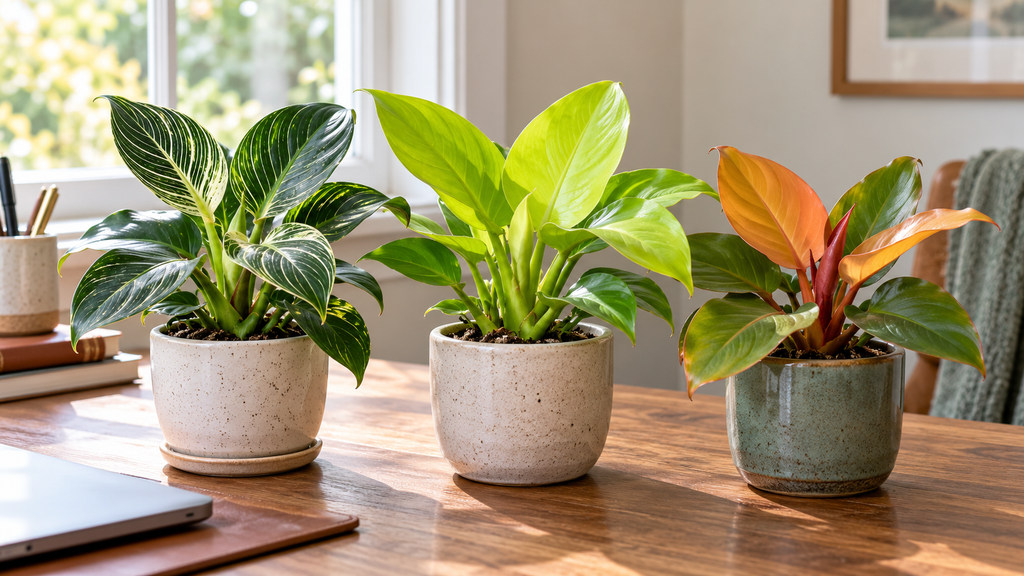
Birkin, Moonlight, Prince of Orange, and Imperial Green grow in concentrated upright forms, but none stays permanently miniature. Birkin may approach three feet tall and wide; Moonlight and Prince of Orange also develop broad leaf spreads. Heartleaf can remain manageable through pruning, although its vines continually extend. Measure the eventual footprint, not the nursery pot.
Rare Philodendron Varieties
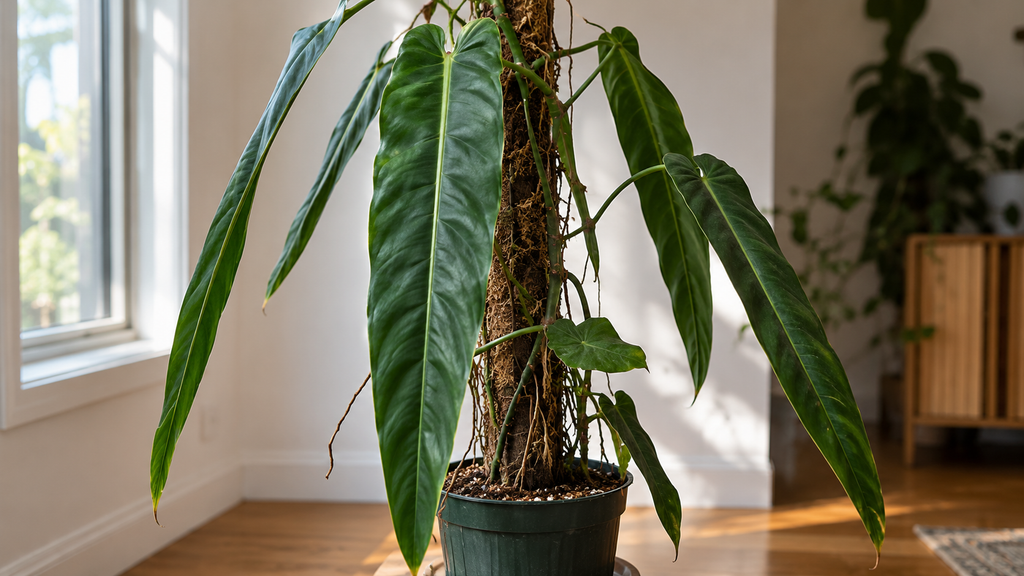
Rarity has three meanings: a limited wild population, poor nursery availability, or intense collector demand. Spiritus-sancti is known for its restricted natural occurrence, while commercially propagated specimens may be easier to find. Melanochrysum and Billietiae are collected for distinctive leaves but are not automatically rare everywhere.
Verify identification and ethical propagation before paying collector prices. Ask for the nursery name, propagation method, and clear photographs of the actual plant rather than relying on a stock photograph. Commercial scarcity can change rapidly, while conservation status describes a different problem.
How to Identify Philodendrons
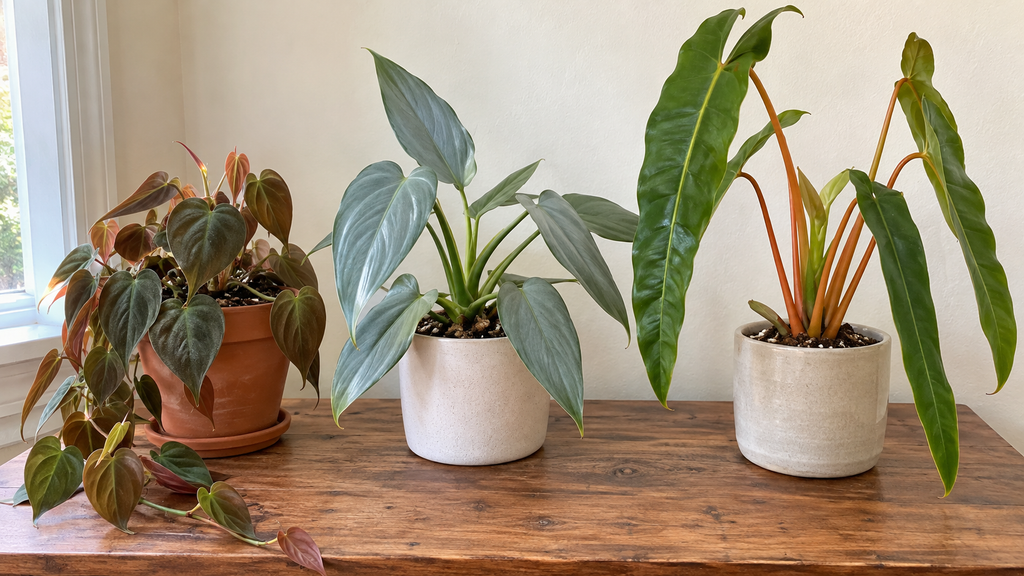
Start with the whole plant: does it climb, crawl, or grow upright? Next compare mature leaf shape, texture, stems, and petioles. Micans is velvet rather than glossy; Billietiae has orange petioles; Squamiferum has bristly stalks. Juvenile leaves can differ sharply from mature foliage, so one leaf rarely proves an identification.
For a useful photo record, capture the entire plant, the newest mature leaf, the stem between nodes, and a close view where each petiole joins the stem. These images provide much stronger evidence than a cropped leaf photograph.
White Princess vs White Wizard vs White Knight
White Princess often has green stems with pinkish markings; White Wizard typically shows greener stems with white; White Knight commonly has darker burgundy stems. All can develop white leaf sectors. Compare several nodes and petioles because individual plants vary.
Lemon Lime vs Moonlight vs Golden Goddess
Lemon Lime trails or climbs, Moonlight stays self-heading, and Golden Goddess extends as a climbing vine. Their similar yellow-green color is less useful than overall structure. Heartleaf versus Micans is simpler: smooth green leaves versus bronze velvet foliage.
Why Do Philodendron Leaves Change Color?
Prince of Orange naturally shifts from orange new leaves to greener mature foliage. Birkin may produce weakly striped, green, or reddish growth. Pink Princess and White Wizard can vary in variegation between leaves; brighter light cannot guarantee pink or white sectors.
Excessively pale leaves have less chlorophyll and may brown more readily under stress. Inspect new growth over time before pruning a changed shoot. A single plain leaf does not necessarily mean permanent reversion. If a branch repeatedly produces only green foliage, compare its growth point with the rest of the plant before deciding whether selective pruning would serve your goals.
Pothos vs. Philodendron
Heartleaf Philodendron and pothos (Epipremnum aureum) both trail, but pothos often has thicker, waxier leaves and grooved petioles. Heartleaf has softer foliage and developing leaves protected by cataphylls. Both climb if supported.
Monstera is a separate genus too, despite the misleading nickname “split-leaf Philodendron.” For the other vine, see how to propagate pothos.
Philodendron Light Requirements
Most varieties prefer bright indirect light. Green Heartleaf tolerates medium or lower light, although slow growth and long internodes may follow. Pink Princess and other variegated selections generally need brighter indirect exposure to grow well.
Velvet foliage can scorch in harsh direct sun. An east-facing window or filtered brighter window is often useful. See bright indirect light for plants for positioning guidance.
How to Water and Pot Philodendrons
How to Water and Pot Philodendrons
How Often Should You Water?
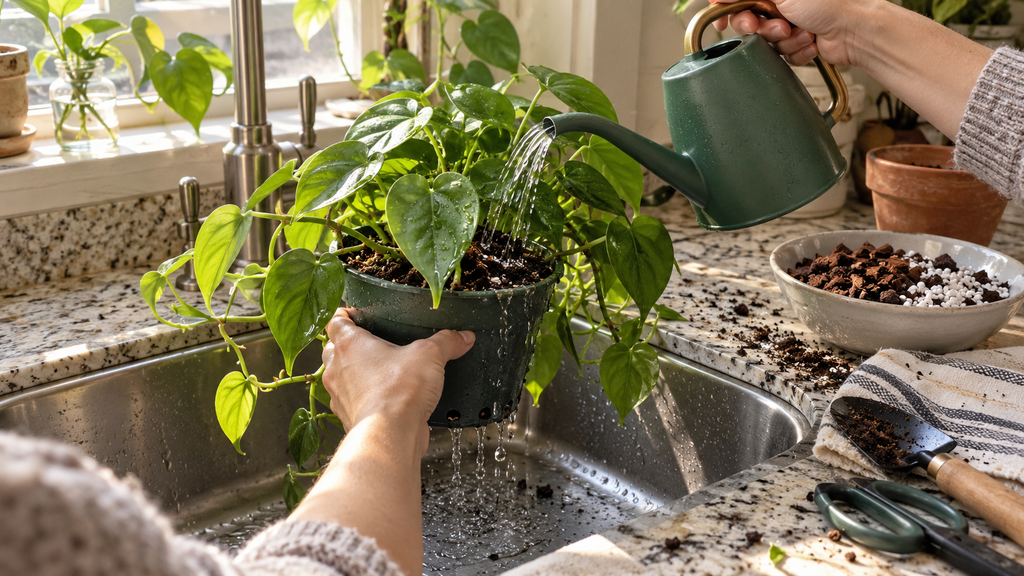
Water when the upper portion of the potting mix starts to dry, rather than on a rigid schedule. Water thoroughly and empty saucers. Light, temperature, pot size, and growing medium all affect frequency.
Use soil moisture to distinguish underwatering from wet-root stress. Lift the pot to notice how its weight changes between wet and dry conditions, and check farther down the mix if the top dries much faster than the root zone. Wilting alone cannot reliably diagnose watering needs. See how to water indoor plants properly.
What Soil and Container Work Best?
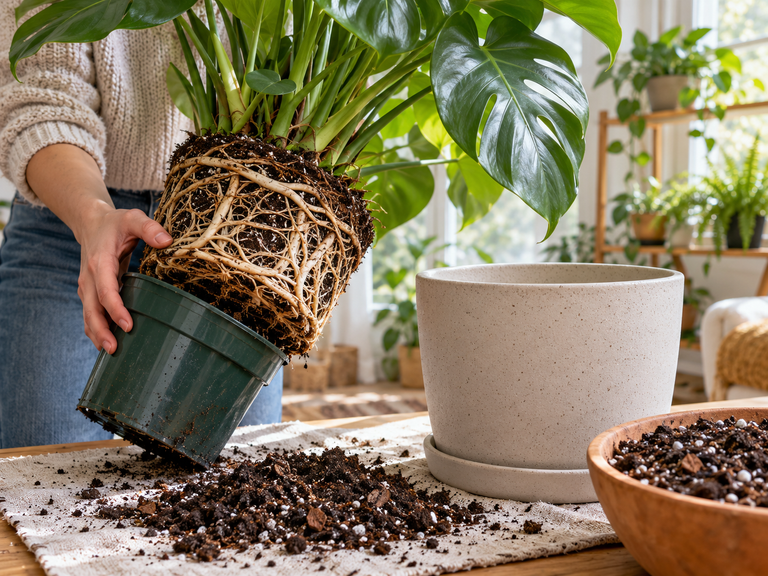
Use a draining indoor potting mix; add perlite or orchid bark if the medium compacts easily. Climbers need stable containers and appropriate vertical support. Crawlers need wide pots with room for horizontal stems. Repot one size up when roots become crowded or the mix deteriorates; avoid burying creeping rhizomes.
What Temperature and Humidity Are Suitable?
Many common varieties grow well around 65–80°F (18–27°C). Average household humidity suits adaptable types, while delicate velvet species appreciate steadier conditions and airflow.
Avoid cold drafts and soggy soil. Feed lightly during active growth rather than trying to fix slow growth with excessive fertilizer. If growth stops in winter while the plant otherwise looks healthy, reduced light may be the explanation; avoid forcing growth with extra water or fertilizer.
Common Philodendron Problems
| Symptom | Check First | Useful Response |
|---|---|---|
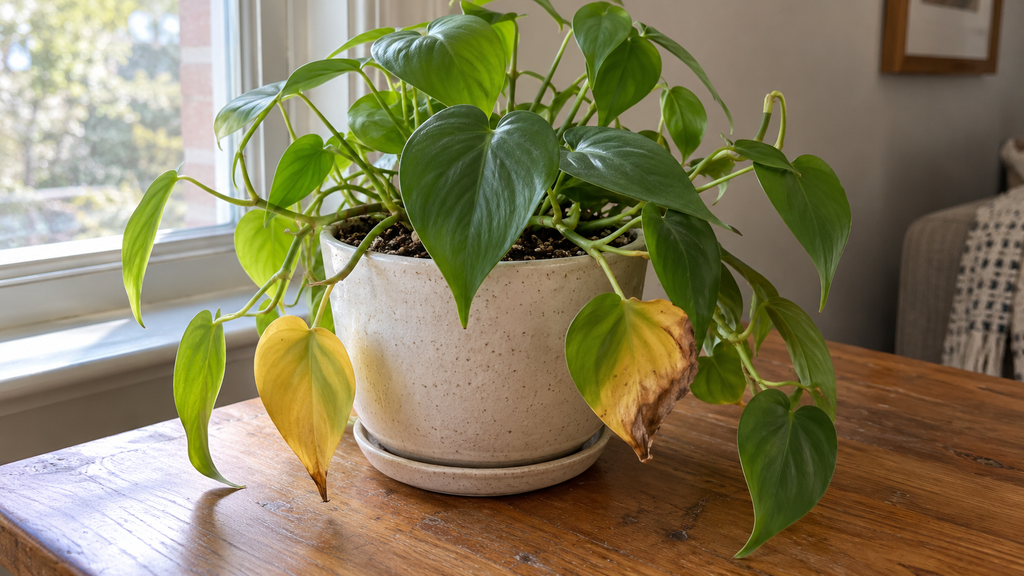
| Yellow leaves, wet soil | Root health and drainage | Let excess moisture escape |
| Drooping, dry soil | Root-ball moisture | Water thoroughly |
| Crispy brown patches | Strong sun or dryness | Adjust light and watering |
| Small new leaves | Light and climbing support | Improve conditions gradually |
| Distorted foliage | Thrips or other pests | Inspect new growth and leaf undersides |
Wet soil can still cause drooping if oxygen-starved or damaged roots cannot supply the leaves. Inspect roots before watering again; see how to fix root rot.
Do not apply pesticides without checking for actual pests; consult common houseplant pests identification.
Are Philodendrons Toxic?
Yes. Philodendrons contain insoluble calcium oxalate crystals that can cause painful mouth irritation, drooling, vomiting, and difficulty swallowing when chewed.
Keep plants and cuttings away from pets and young children. If a pet chews a plant, contact a veterinarian or animal poison-control service promptly. The ASPCA’s pet-safety guidance explains these effects.
FAQs About Philodendron Varieties
How Many Philodendron Varieties Are There?
Kew currently recognizes 629 accepted species. Nurseries offer additional hybrids and named cultivated selections.
What Are the Main Philodendron Types?
Climbing, crawling, and upright are the main growth habits. Some climbers are grown as trailing plants.
What Is the Easiest Philodendron Indoors?
Heartleaf is among the easiest. Brasil and Imperial Green are also approachable under suitable indoor conditions.
Which Philodendron Handles Low Light?
Green Heartleaf tolerates lower light, but it grows better with adequate indirect light. Complete darkness is unsuitable.
Which Philodendrons Suit Hanging Baskets?
Heartleaf, Brasil, Micans, and Lemon Lime have flexible vines that cascade from baskets.
Which Philodendron Stays Small?
Birkin stays relatively contained while young. Moonlight and Prince of Orange are upright but grow wider with age.
How Do I Identify My Philodendron?
Compare growth habit, several leaves, stem color, and petioles. Juvenile leaf shape alone can be misleading.
Which Philodendrons Have Pink, White, or Silver Leaves?
Pink Princess has pink areas; White Wizard and White Princess have white variegation; Silver Sword and Mamei have silver-toned foliage.
Which Philodendrons Have Velvet Leaves?
Micans, Gloriosum, Melanochrysum, and Verrucosum are well-known velvet-leaved choices.
Which Philodendrons Have Lobed Leaves?
Pedatum, Squamiferum, Florida Beauty, and Xanadu develop divided foliage, especially when mature.
Why Do Philodendron Leaf Shapes Change?
Some species develop larger, longer, or more divided leaves as they mature, especially when supported for climbing.
What Is the Holy Grail Philodendron?
Philodendron spiritus-sancti is commonly called the Holy Grail, although collector fame and wild rarity are different concepts.
Can Philodendrons Root in Water?
Many trailing types root from stem cuttings containing viable nodes. Transfer rooted cuttings to suitable potting mix.
Do All Philodendrons Need Moss Poles?
No. Climbers benefit from support; crawlers need horizontal room; upright types generally support themselves.
Is Monstera a Philodendron?
No. Monstera and Philodendron are separate genera in the Araceae family, despite confusing common names.
Can Philodendrons Grow Outdoors?
Many can grow outside in warm, frost-free climates with suitable shade and drainage. Protect them from cold.
Are Philodendrons Toxic to Pets?
Yes. Chewed foliage can cause oral irritation, drooling, and vomiting. Seek veterinary guidance after suspected ingestion.

Myra is the founder and lead writer of Plantsaholic. She shares practical, research-backed advice on indoor plants, outdoor gardening, flowers, herbs, succulents, and everyday plant care. Her goal is to help gardeners of all experience levels grow healthier plants through simple, easy-to-follow gardening guides.